Table of Contents
- The True Cost of At-Home Chemical Peeling
- At-Home vs Professional Chemical Peel: Cost and Results
- Professional Chemical Peel Cost Breakdown
- How Often to Use an At-Home Chemical Peel for Results
- Chemical Peel Alternatives to Consider
- Factors That Affect Your Actual Savings
- Making the Right Choice for Your Skin and Budget
- Frequently Asked Questions
Last Updated: October 7, 2026
The True Cost of At-Home Chemical Peeling
Whether at-home chemical peeling is cheaper than professional treatments depends on what you measure. The upfront product cost is lower than a single professional session, but total cost of ownership, frequency, product quantity, and results, tells a more complex story.
Many assume buying a glycolic or salicylic acid peel online automatically saves money, but real savings depend on consistency, skin type, and realistic expectations about frequency.
At-Home vs Professional Chemical Peel: Cost and Results
A professional chemical peel typically runs $150 to $300 per session for a superficial to medium-depth peel, and $300 to $600 or more for deeper peels or higher-cost metro areas.
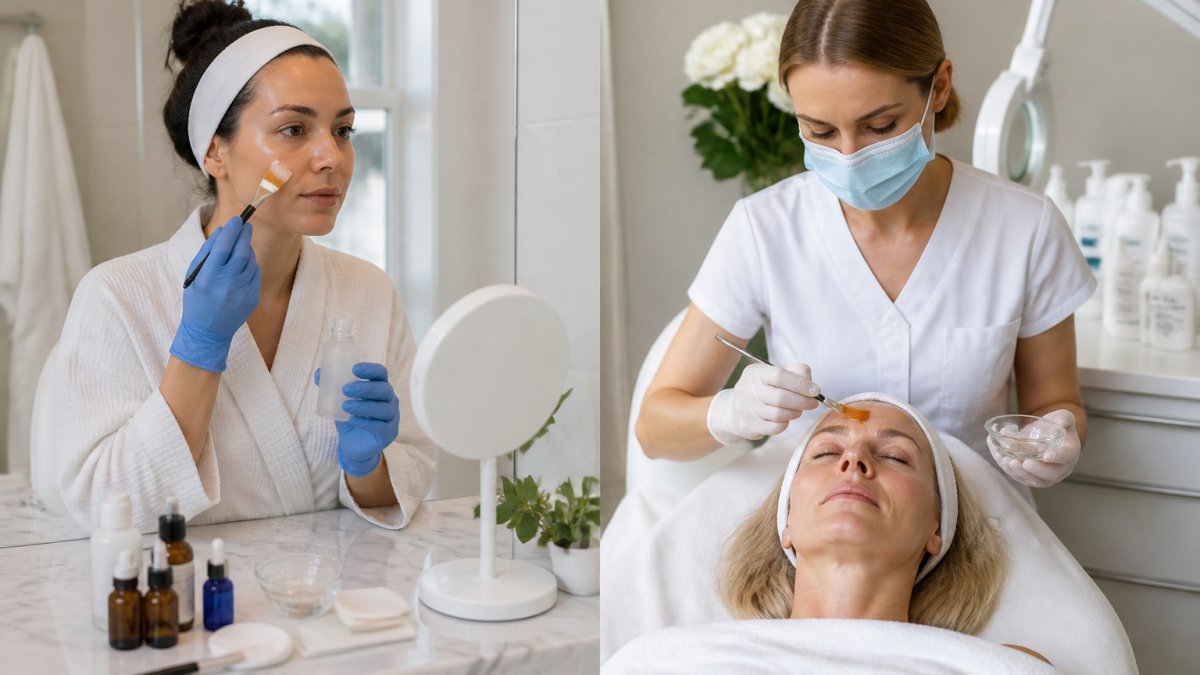
What matters is cost per treatment, which depends on bottle size, concentration, and how much product each application consumes.
Here is the like-for-like math, using numbers you can swap for your own.
Professional cost per treatment. A single $200 session is $200 per treatment; a package of six at $1,000 is about $167 each.
On raw cost per application, at-home wins by a wide margin, often by a factor of 50 or more.
The caveats are where the comparison gets interesting.
Strength is not equivalent. Professional peels use concentrations and pH levels unavailable over the counter, and a provider can layer acids, adjust contact time, and neutralize on the fly (the FDA).
Frequency is not equivalent. A professional medium-depth peel might be done every 4 to 6 weeks, with three to six sessions to reach a goal.
Results are not equivalent. Professional peels produce visible change faster, often within 1 to 2 weeks. At-home peels typically take 4 to 8 weeks of consistent use to improve tone, texture, or mild acne.
| Aspect | Professional Peel | At-Home Chemical Peel |
|---|---|---|
| Cost per session | $150-$600 | |
| Active ingredient strength | Medium to high, provider-adjusted | Varies by product; OTC limits apply |
| Application | Applied by trained provider | Self-applied |
| Post-care support | Included | Self-managed |
| Risk of application error | Low | Medium to high |
| Results timeline | Visible in 1-2 weeks | 4-8 weeks for cumulative results |
| Cost to reach a comparable result | Often $600-$1,800 |
Before you compare, write down three numbers: the price of the at-home product, the number of applications you realistically get from it, and the number of professional sessions you would otherwise book. Divide the first by the second and multiply the third by the session fee. That is the only comparison that answers the question.
For resilient skin with prior acid experience, at-home treatments often deliver comparable results at a fraction of the cost per treatment. For someone new to peels, with sensitive skin, or with deeper scarring at-home products cannot reach, the professional route can be cheaper overall because it avoids months of spending on products that were never strong enough to work.
Professional Chemical Peel Cost Breakdown
A single professional session breaks down into several components. The chemical solution itself is only part of the cost; you’re also paying for the provider’s expertise, consultation, facility overhead, and follow-up care.
Ask your provider whether the quoted price includes post-peel skincare products. Some practices bundle them in; others charge separately. This can add $50-$150 to your total cost per session.
Most people don’t stop at one professional peel. For deeper concerns like acne scars or post-inflammatory hyperpigmentation, dermatologists typically recommend three to six sessions spaced 4-6 weeks apart.
How Often to Use an At-Home Chemical Peel for Results
At-home chemical peel frequency depends on peel strength and your skin’s tolerance. Superficial peels are typically used once weekly, medium-strength peels every two to four weeks, and stronger peels once monthly or less.
Here’s the practical reality: if you’re using an at-home chemical peel once per week, a single bottle might last four to eight weeks depending on the product size and how much you apply. That means you’re buying roughly six to twelve bottles per year.
That’s still less than professional treatments, but not the bargain it first appears.
Using an at-home chemical peel too frequently is a common mistake that leads to compromised skin barrier, chronic irritation, and redness. This actually increases your skincare spending because you’ll need additional products to repair damage. Less frequent, consistent use beats aggressive overuse every time.
Timeline matters financially too. Professional peels often show results within one to two weeks; at-home peels typically require four to eight weeks of consistent use before meaningful improvement in acne, texture, or hyperpigmentation. Abandon the routine early and you’ve wasted the product cost without the benefit.
Chemical Peel Alternatives to Consider
If cost is your primary concern, other exfoliation methods exist. Physical exfoliants, enzyme-based products, and gentler chemical exfoliants like lower-concentration AHAs and BHAs cost less upfront but take longer to deliver visible results. Retinol is another alternative: less expensive than chemical peels and addressing similar concerns, aging, texture, and acne, through a different mechanism, with results building slowly over months. Microneedling is sometimes positioned as a middle ground; at-home devices require careful technique and carry infection risks, while professional microneedling costs $200-$500 per session. The trade-off with alternatives is time versus money: cheaper options take longer to work, while professional treatments deliver faster results at a higher cost per session.
Factors That Affect Your Actual Savings
Most cost comparisons stop at the price of the bottle and the session. That isn’t total cost of ownership, which is why so many people are surprised by what they actually spend over a year. Here’s the full model, with assumptions stated so you can substitute your own numbers.
Assumptions used below. Prices are in U.S. dollars and reflect typical 2026 retail and clinic ranges, not quotes. A year is 52 weeks. At-home frequency is once weekly for a superficial peel; professional frequency is one session every 6 weeks, or about 8 to 9 sessions per year, reflecting someone actively treating a concern rather than maintaining.
At-home total cost of ownership, one year.
- Peel product: 6 to 12 bottles per year if you treat weekly and a bottle lasts 4 to 8 weeks.
- Sunscreen: a daily broad-spectrum SPF 30 or higher is non-negotiable during any peel routine.
- Barrier and aftercare products: a fragrance-free moisturizer and a gentle cleanser.
- Irritation or repair products: optional but common.
- Shipping: if you order online and do not hit free-shipping thresholds.
- Wasted product: opened AHA and BHA products lose potency, and most have a shelf life of 6 to 12 months after opening. If you buy three bottles and finish one, you paid for three.
A realistic at-home annual range is roughly $330 to $1,610.
Professional total cost of ownership, one year.
- Sessions: 8 to 9.
- Consultation: often credited toward treatment.
- Post-peel kit: if not bundled.
- Sunscreen and barrier products: because you need them either way.
- Time off or downtime: not a cash cost, but a real one if you cannot work during visible peeling.
The break-even calculation. At-home becomes cheaper when your annual at-home spend divided by your annual professional spend is less than 1. In the middle estimates above, that ratio is roughly $700 divided by $2,300, or about 0.3.
But break-even flips when the at-home routine cannot reach the concern at all. Spend $700 a year on at-home peels for 18 months and still need professional treatment for scarring, and you didn’t save $2,300. Savings only exist if the at-home routine produces a result you’d otherwise pay a provider to produce.
The variables that move the number most.
- Your skin type and sensitivity. Resilient skin tolerates stronger at-home peels more often, which means fewer bottles per result. Sensitive skin needs gentler products and longer timelines, which raises total product cost before you see change.
- Your specific concern. Mild acne, dullness, and uneven tone respond to at-home peels. Cystic acne, significant scarring, and deeper pigmentation often do not, at least not at over-the-counter strengths.
- Product waste and shelf life. Buying in bulk to save per-ounce only saves money if you finish the product before it degrades. For most people, smaller bottles used consistently beat larger bottles used sporadically.
- Your time. Professional sessions take 1 to 2 hours including consultation and aftercare. At-home sessions take 10 to 20 minutes, but you also absorb the research, product selection, and monitoring. If your time has a high dollar value, the professional route narrows the gap.
- Safety-adjusted savings. Misuse of an at-home peel can cause burns, post-inflammatory hyperpigmentation, or a compromised barrier, and treating those can mean a dermatologist visit, prescription topicals, and months of gentle-only skincare. A single urgent care or dermatology visit can run $150 to $400 or more out of pocket depending on insurance. Professional supervision exists partly to prevent that outcome, and for some skin types and histories that prevention is worth the premium.
If you have a history of keloids, active cold sores, recent isotretinoin use, or you are pregnant or breastfeeding, do not start an at-home peel routine without talking to a clinician first. The cost of a bad reaction is not just financial.
The real cost comparison is total annual spend divided by the results you actually achieve, not price per bottle versus price per session. At-home peels win on cost per treatment by a wide margin. Professional peels often win on cost per visible result when the concern is deeper than an over-the-counter peel can reach, or when a bad reaction would cost more than the sessions you were trying to avoid.
Making the Right Choice for Your Skin and Budget
Choose professional chemical peels if you want to address a specific concern quickly, are new to peels, have sensitive skin, or value expert guidance and safety. The higher cost per session is offset by faster results and lower risk of mistakes.
Choose at-home chemical peels if you have experience with exfoliating treatments, your skin tolerates acids well, you’ll commit to consistent use over several months, and you want to minimize upfront costs. You’ll save money if you follow through, but the timeline is longer.
A hybrid approach works for many people: start with one or two professional peels to see how your skin responds and what strength you need, then maintain results with at-home treatments between sessions. It costs more than either option alone but often delivers the best results relative to total spend.
Makeup Artist’s Choice offers professional-grade at-home chemical peels formulated with glycolic, lactic, salicylic, and TCA options, made in the USA since 1997.
The question “Is at-home chemical peeling actually cheaper?” has a real answer, but it depends on your skin, commitment level, and what you’re measuring. Compare a single product purchase to a single professional session and at-home wins; compare total cost over a year and factor in results, and the answer is less clear.
Frequently Asked Questions
Do at-home chemical peels really work?
Yes, at-home chemical peels deliver measurable results when used correctly. Professional-grade formulations containing AHAs, BHAs, and other active ingredients exfoliate dead skin cells and stimulate collagen production. Results depend on peel strength, skin type, and consistent application. Superficial peels show visible improvement in texture and tone within days; medium-depth peels address acne scars and deeper sun damage over multiple sessions. Success requires following application instructions precisely and using appropriate aftercare products to protect your skin barrier.
How often do you need to use an at-home chemical peel?
Treatment frequency depends on peel strength and your skin tolerance. Superficial peels can typically be used weekly or every two weeks. Medium-strength peels work best every 3-4 weeks to allow skin recovery. Start conservatively, especially if you have sensitive skin, and adjust based on how your skin responds. Overusing peels risks irritation and barrier damage. Most people see cumulative benefits over 4-6 treatments, with results improving as skin builds tolerance and cellular turnover increases.
Is a chemical peel worth the money?
Whether a chemical peel is worth the cost depends on your specific skin concerns and budget. At-home peels offer significant value for addressing acne, uneven tone, and mild aging signs at a fraction of professional pricing. However, deep wrinkles and severe scarring may require professional-grade or laser treatments for meaningful results. Calculate your long-term cost by multiplying treatment frequency by product cost over one year, then compare to professional salon visits.
What can I do instead of a chemical peel?
Chemical peel alternatives include retinol products, which increase cell turnover over time; vitamin C serums for antioxidant protection and brightening; physical exfoliants like gentle scrubs; enzyme-based exfoliants derived from fruit; microdermabrasion tools for mechanical exfoliation; and prescription-strength treatments like tretinoin. Non-invasive professional options include microneedling, laser resurfacing, and hydrafacials. Each alternative works differently and addresses specific concerns. Retinol and vitamin C are gentler but slower-acting; professional treatments are faster but costlier. Your choice depends on skin sensitivity, budget, and how quickly you want results.