Table of Contents
- What Are At-Home Chemical Peels and How Do They Work?
- At-Home Chemical Peel Safety: What You Need to Know Before Starting
- Chemical Peel Recovery Time: What to Expect
- Best Chemical Peel for Beginners: Where to Start
- Real Results: What At-Home Chemical Peels Actually Address
- How to Prepare and Apply an At-Home Chemical Peel Correctly
- Who Should Avoid At-Home Chemical Peels
- Frequently Asked Questions
Last Updated: September 18, 2026
What Are At-Home Chemical Peels and How Do They Work?
At-home chemical peels effective at using chemical exfoliants, typically glycolic, salicylic, lactic, or trichloroacetic acid, to remove dead skin cells and stimulate cell turnover. These acids dissolve the bonds holding dead skin cells together, revealing fresher, smoother skin underneath. Whether at-home chemical peels are effective depends entirely on using the right concentration for your skin type and following proper application protocols.
At-home versions use lower concentrations than professional peels, meaning slower results but significantly lower risk of chemical burn. Consistent use addresses fine lines, texture irregularities, hyperpigmentation, and post-inflammatory marks left by acne.
Makeup Artist’s Choice has specialized in professional-grade at-home chemical peels since 1997, offering formulations with carefully calibrated concentrations and comprehensive guidance on application and aftercare.
The most common misconception is that stronger concentration equals faster results. In reality, skin tolerance matters more than strength. A lower-concentration peel used consistently outperforms a high-concentration peel that causes irritation and forces you to skip applications for weeks.
At-Home Chemical Peel Safety: What You Need to Know Before Starting
Safety separates effective treatments from dangerous DIY attempts. The difference comes down to understanding concentration levels, patch testing, and respecting your skin’s barrier function.
Patch Testing and Skin Barrier Protection
Before applying any chemical peel to your full face, perform a patch test on a small, inconspicuous area like the inside of your jawline or behind your ear. Apply the product exactly as directed, leave it on for the full recommended time, and observe your skin’s reaction over 24-48 hours. This step prevents most adverse reactions.
Your skin barrier is your first line of defense against irritation and infection. Chemical exfoliation temporarily compromises this barrier, but the key is not to damage it beyond its capacity to repair. Signs of barrier damage include persistent redness, burning sensations that don’t subside within minutes, flaking beyond a week, or increased sensitivity to other products. If you experience these, stop using the peel immediately and focus on barrier repair with gentle moisturizers and broad-spectrum sunscreen.
Never apply a chemical peel to compromised skin, active acne, open wounds, severe dermatitis, or recent sunburn, your skin barrier is already under stress.
Concentration Levels and Professional-Grade Formulas
Concentration percentage directly determines both efficacy and risk. Concentration percentage directly determines both efficacy and risk. Most achieve excellent results at lower concentrations.
pH level matters as much as concentration. Makeup Artist’s Choice formulates its peels with proper pH balance for home application, ensuring active exfoliation without professional-strength risks.
Never use a chemical peel if you’re currently taking isotretinoin (Accutane) or other medications that increase photosensitivity or compromise skin integrity. These combinations can cause severe, irreversible damage. Always disclose your full medication list when choosing a peel strength.
Chemical Peel Recovery Time: What to Expect
Understanding recovery timelines helps you plan treatments around your schedule and manage expectations realistically.
Immediate Effects and Downtime by Peel Strength
Mild peels show mild redness fading within 2-4 hours, with slight flaking peaking around day 3-4 and subsiding by day 7. Most people return to normal activities immediately, though avoid intense exercise or sweating for 24 hours.
Moderate peels produce redness lasting 4-8 hours with visible peeling for 5-7 days. Some experience mild swelling around the eyes. Plan for 2-3 days at home if appearance matters for your schedule.
Stronger peels create significant downtime with pronounced redness, swelling, and flaking lasting 7-10 days. This is normal and temporary, your skin’s natural response to exfoliation, not damage.
Aftercare and Sun Protection During Healing
The 48 hours following a peel are critical. Use only gentle, fragrance-free products and avoid hot water, harsh cleansers, and active ingredients like retinol or vitamin C. Your skin needs to focus on barrier repair.
Sun protection is non-negotiable. Your skin is photosensitive after chemical exfoliation, and UV exposure can cause permanent hyperpigmentation. Use broad-spectrum sunscreen with at least SPF 30 daily, reapplying every two hours if outdoors (the American Academy of Dermatology). Ideally, stay out of direct sun for the first week.
Moisturizing during recovery prevents excessive dryness and supports barrier healing. Apply a hydrating moisturizer immediately after the peel (once the acid is neutralized), then twice daily during the peeling phase. Hyaluronic acid serums followed by occlusive moisturizers work well for most people.
Best Chemical Peel for Beginners: Where to Start
Choosing your first peel matters. Starting too strong creates unnecessary irritation; starting too weak may not deliver visible results.
Glycolic and Lactic Acid: Entry-Level Options
Glycolic acid is the gold standard for beginners, the smallest hydroxy acid molecule, it penetrates efficiently with minimal irritation. Glycolic acid is the gold standard for beginners, the smallest hydroxy acid molecule, it penetrates efficiently with minimal irritation. It works best for fine lines, dull texture, and mild hyperpigmentation.
Lactic acid is gentler than glycolic acid and better for sensitive skin. Lactic acid is gentler than glycolic acid and better for sensitive skin. It is an excellent starting point for reactive or rosacea-prone skin. Fewer people experience adverse reactions.
Salicylic acid is oil-soluble, making it ideal for acne-prone and oily skin. It penetrates pores to address congestion and post-inflammatory marks from breakouts. Salicylic acid is oil-soluble, making it ideal for acne-prone and oily skin. It penetrates pores to address congestion and post-inflammatory marks from breakouts. It’s less effective for fine lines and general anti-aging compared to glycolic acid.
For your first peel, choose based on your primary skin concern, not just “what’s mildest.” Glycolic acid for anti-aging and texture, lactic acid for sensitivity, salicylic acid for acne. Matching your concern to the right acid type ensures you see results and stay motivated to continue treatment.
Building Tolerance and Progressing Strength
After 4-6 weeks of weekly applications, your skin develops tolerance with less redness, faster healing, and less flaking. Progress by increasing frequency to twice weekly at the same strength, or move to a higher concentration while maintaining weekly frequency.
A logical progression: start with a lower concentration weekly for 4-6 weeks, then move to a higher concentration weekly or increase to twice weekly. Most people reach their optimal strength within 3-4 months.
Never jump multiple strength levels at once. Accelerating results leads to chemical burns, prolonged redness, or barrier damage. Slow progression is the only long-term approach.
Real Results: What At-Home Chemical Peels Actually Address
At-home chemical peels effective for specific concerns. Understanding what they can and cannot do prevents disappointment.
Fine Lines, Texture, and Acne Scars
Fine lines respond well to consistent chemical exfoliation through increased cell turnover and collagen stimulation. Results typically appear after 8-12 weeks of consistent weekly treatments. Deep wrinkles improve more slowly and may require professional-grade peels or combination treatments.
Skin texture, roughness, enlarged pores, dull appearance, improves noticeably within 4-6 weeks. Chemical exfoliation is particularly effective for texture because it directly addresses the accumulation of dead skin cells that create a rough surface.
Shallow, post-inflammatory scars respond well to chemical peels. Deeper, pitted scars require more aggressive treatments like professional TCA peels, microneedling, or laser resurfacing.
Hyperpigmentation and Post-Inflammatory Marks
Post-inflammatory hyperpigmentation responds exceptionally well to consistent chemical exfoliation, one of the most effective uses for at-home peels. Most people see significant improvement within 8-12 weeks.
How to Prepare and Apply an At-Home Chemical Peel Correctly
Proper application technique determines whether you achieve results or waste money on an ineffective treatment.
Pre-Peel Skin Preparation
Begin with clean, completely dry skin. Use a gentle cleanser, then wait at least 30 minutes before applying the peel. Any residual moisture interferes with even penetration. Pat your face dry with a clean towel.
Step-by-Step Application and Neutralization
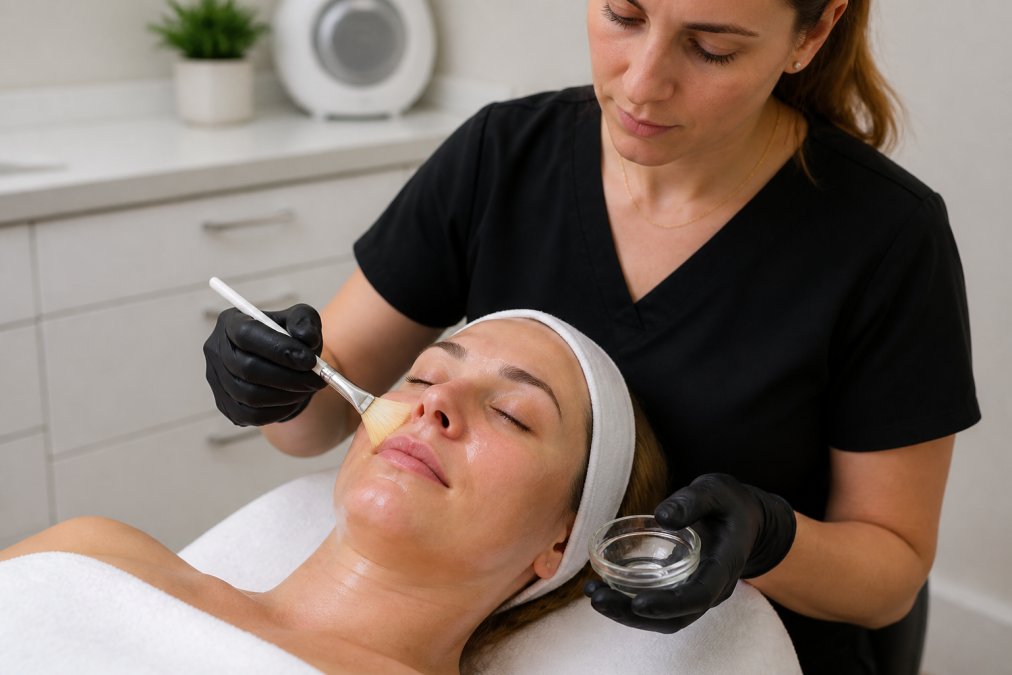
Apply the peel in thin, even layers using a brush or applicator. Start with your forehead, move to cheeks, then chin and neck. Work quickly but carefully for even coverage and consistent contact time. Avoid the eye area, lips, and areas with active breakouts or open wounds.
| Step | Duration | Frequency |
|---|---|---|
| Patch test | 24-48 hours observation | Before first use |
| Application | 5-15 minutes (depends on product) | Weekly or as directed |
| Neutralization | Immediate upon timer | Every application |
| Recovery | 3-7 days visible peeling | Ongoing after each peel |
| Results visible | 4-8 weeks | With consistent use |
Who Should Avoid At-Home Chemical Peels
Certain conditions make at-home chemical peels unsafe or ineffective. Understanding these contraindications prevents complications.
Frequently Asked Questions
Do at-home chemical peels really make a difference for skin texture?
Yes, at-home chemical peels effectively improve skin texture by accelerating cell turnover and stimulating collagen production. Glycolic and salicylic acid peels reduce fine lines and roughness within 4-6 weeks of consistent use. Results depend on peel strength, concentration percentage, and your skin type, professional-grade formulas deliver more noticeable texture refinement than over-the-counter options, though they require proper preparation and aftercare.
How long does a chemical peel last on your face?
At-home chemical peel results typically last 4-8 weeks, depending on the peel strength and your skin’s cell turnover rate. Lighter peels show benefits for 4-6 weeks, while stronger formulas extend results longer. To maintain improvements, most users repeat peels every 2-4 weeks or follow a maintenance schedule recommended for their skin type and the specific acid treatment they’re using.
What are the risks of using high-concentration acids at home?
High-concentration acids carry risks of chemical burns, severe skin irritation, and damage to the skin barrier if applied incorrectly. Without proper neutralization, pH control, and professional guidance, you may experience prolonged redness, hyperpigmentation, or infection. Starting with lower concentrations, patch testing, and following detailed application instructions, including proper timing and neutralization, significantly reduces these risks and makes professional-grade peels safer for home use.
Can I do a chemical peel on myself if I have sensitive skin?
Yes, but with careful preparation. Sensitive skin requires starting with the gentlest options like lactic acid, always performing a patch test first, and spacing peels 3-4 weeks apart. Avoid chemical peels if you have active inflammation, compromised skin barrier, or are using retinoids or vitamin C without a break-in period. Consult a dermatologist before starting if you have conditions like rosacea or eczema, and always use broad-spectrum sunscreen and gentle moisturizers during recovery.