Table of Contents
- What Is Post-Inflammatory Hyperpigmentation and How It Differs From Other Dark Spots
- How Long Does Post-Inflammatory Hyperpigmentation Last Without Treatment
- Step 1: Protect Your Skin With Daily Sun Protection
- Step 2: Establish a Gentle Cleansing and Moisturizing Routine
- Step 3: Use Topical Ingredients for Hyperpigmentation
- Step 4: Try a Mandelic Acid Peel for Dark Spots
- How to Fade Dark Spots After Acne: A Beginner-Friendly Routine
- When to See a Dermatologist
- Frequently Asked Questions
Last Updated: October 6, 2026
What Is Post-Inflammatory Hyperpigmentation and How It Differs From Other Dark Spots
Post-inflammatory hyperpigmentation (PIH) is excess melanin production that occurs after your skin experiences inflammation, irritation, or injury. When skin heals from acne, a cut, or aggressive treatment, melanocytes (the cells that produce melanin) become overactive, creating dark marks that linger long after the original problem resolves.
PIH affects all skin types, though it’s more noticeable on deeper skin tones. Unlike some forms of discoloration, post-inflammatory hyperpigmentation typically fades on its own over time with proper care.
Common Causes: Acne, Irritation, and Inflammation
Acne is the leading trigger for PIH: picking at blemishes, harsh treatments, or severe breakouts signal your skin to produce extra melanin. But acne isn’t the only culprit.
Other common causes include:
- Skin injuries: Cuts, burns, or surgical wounds
- Aggressive treatments: Over-exfoliation, strong peels, or laser procedures
- Irritant reactions: Allergic contact dermatitis or sensitivity to skincare products
Severity depends on how intense the inflammation was and how your skin responds. Some people develop mild discoloration that fades in weeks; others get darker marks that persist for months.
PIH vs. Melasma and Post-Inflammatory Erythema
Distinguishing PIH from similar conditions matters because treatment approaches differ.
Melasma is triggered by sun exposure, hormones, or genetics.
Post-inflammatory erythema (PIE) is redness rather than darkening: after inflammation subsides, dilated blood vessels create pink or red marks instead of brown ones, requiring different treatment strategies.
How to tell the difference:
| Condition | Appearance | Trigger | Timeline |
|---|---|---|---|
| PIH | Brown or dark marks | Acne, injury, irritation | Fades over months to years |
| Melasma | Symmetric brown patches | Sun, hormones, genetics | Persistent without treatment |
| PIE | Pink or red marks | Inflammation | Can fade faster than PIH |
The key distinction: PIH follows a specific inflammatory event. If your dark spots appeared after acne or an injury, you’re likely dealing with post-inflammatory hyperpigmentation.
How Long Does Post-Inflammatory Hyperpigmentation Last Without Treatment
The timeline for PIH varies widely. Many people see improvement within 3 to 6 months with sun protection alone; others have marks that persist 1 to 2 years or longer.
Several factors influence how quickly your skin recovers:
- Skin tone: Deeper skin tones typically experience longer-lasting PIH because melanin is more visible
- Severity of inflammation: Severe acne or injury creates darker, more stubborn marks
- Sun exposure: UV rays darken existing hyperpigmentation and slow fading
Without intervention, you rely on natural cell turnover to shed pigmented cells, which works but is slow. Active treatment, sun protection, topical ingredients, and gentle exfoliation speed up the process significantly.
Step 1: Protect Your Skin With Daily Sun Protection
Sun protection is non-negotiable when fading post-inflammatory hyperpigmentation. UV exposure darkens existing marks and triggers new pigmentation, undoing your progress.
Use broad-spectrum sunscreen every single day:
- Apply SPF 30 or higher (SPF 50 is better for PIH)
- Reapply every 2 hours if you’re outdoors
- Use enough: a quarter-teaspoon for your face
Beyond sunscreen, add physical barriers:
- Wear a wide-brimmed hat when outside
- Use an umbrella during peak sun hours (10 a.m. to 4 p.m.)
- Seek shade whenever possible
A single day of unprotected sun can noticeably darken marks. Consistency matters more than perfection, daily protection compounds over weeks and months.
Step 2: Establish a Gentle Cleansing and Moisturizing Routine
A healthy skin barrier supports faster healing and prevents new inflammation that worsens PIH. Harsh cleansing strips your skin’s protective layer, triggering more melanin production.
Cleanse gently twice daily:
- Use a mild, pH-balanced cleanser
- Avoid scrubs, washcloths, or physical exfoliation on affected areas
- Rinse with lukewarm water (hot water irritates)
Moisturize immediately after cleansing:
- Apply moisturizer to damp skin to lock in hydration
- Choose a formula suited to your skin type
- Look for ingredients like ceramides, glycerin, or hyaluronic acid
A compromised barrier becomes inflamed more easily, activating melanocytes. Keeping it intact prevents this cascade and makes every other treatment more effective.
Step 3: Use Topical Ingredients for Hyperpigmentation
Active ingredients accelerate fading by either inhibiting melanin production or speeding up cell turnover.
Vitamin C and Antioxidants
Vitamin C brightens skin by inhibiting tyrosinase, an enzyme essential for melanin production, and provides antioxidant protection against UV damage that darkens marks.
How to use:
- Apply a stabilized vitamin C serum in the morning (before sunscreen)
- Use 10-20% concentration for best results
- Layer under moisturizer
Vitamin C works best when paired with vitamin E and ferulic acid, which enhance its stability and effectiveness.
Niacinamide and Azelaic Acid
Niacinamide reduces inflammation and supports barrier function. Azelaic acid inhibits melanin production and has mild antibacterial properties, making it especially useful if PIH followed acne.
How to use:
- Niacinamide: Use 4-5% concentration in serums or moisturizers; can be used twice daily
- Azelaic acid: Apply 15-20% formulations once or twice daily
- Both are well-tolerated on sensitive skin
Azelaic acid is particularly effective for post-inflammatory hyperpigmentation triggered by acne because it addresses both the pigmentation and residual bacteria.
Kojic Acid and Licorice Root Extract
Kojic acid inhibits tyrosinase and is gentler than some alternatives. Licorice root reduces melanin production and inflammation simultaneously.
How to use:
- Kojic acid: Apply 1-2% concentrations once or twice daily
- Licorice root: Use in serums or moisturizers; typically 2-5% concentration
- Both work well in combination with other brightening ingredients
These ingredients suit sensitive skin types well and pair nicely with vitamin C for enhanced results.
Retinoids and Alpha Hydroxy Acids
Retinoids (including tretinoin) increase cell turnover, helping skin shed pigmented cells faster. Alpha hydroxy acids (AHAs) chemically exfoliate the surface, promoting renewal.
How to use retinoids:
- Start with low concentrations (0.025%) and increase gradually
- Use at night only (retinoids increase sun sensitivity)
- Begin with 2-3 times per week; increase frequency as tolerated
How to use AHAs:
- Glycolic acid and lactic acid are the most common AHAs
- Start with 5-10% concentrations, 2-3 times per week
- Increase frequency only after your skin adapts
Retinoids are powerful but require patience; AHAs work faster but can irritate sensitive skin if overused. Never combine them on the same night, alternate instead.
Retinoids and AHAs increase sun sensitivity significantly. Skipping sunscreen while using these ingredients will darken your PIH instead of fading it. This is the most common mistake people make.
Step 4: Try a Mandelic Acid Peel for Dark Spots
Mandelic acid is an AHA derived from bitter almonds. Its larger molecular size than glycolic acid means it penetrates more slowly and gently, ideal for sensitive skin and post-inflammatory hyperpigmentation.
A mandelic acid peel accelerates cell turnover, helping skin shed pigmented cells faster than topical serums alone.
What to expect from a mandelic acid peel:
- Mild redness and flaking for 2-3 days post-treatment
- Visible lightening of dark spots within 1-2 weeks
- Progressive improvement over 4-6 weeks as new skin cells surface
Mandelic acid peels suit all skin tones because they’re less likely to trigger post-inflammatory hyperpigmentation themselves (unlike stronger peels).
How to Fade Dark Spots After Acne: A Beginner-Friendly Routine
If you’re new to treating post-inflammatory hyperpigmentation, a structured routine prevents overwhelm and irritation from combining too many actives at once.
Product Order and Application Frequency
Morning routine:
- Cleanse with a gentle, pH-balanced cleanser
- Pat skin dry gently
- Apply vitamin C serum (wait 1 minute for absorption)
- Apply moisturizer
- Apply broad-spectrum SPF 50 sunscreen
Evening routine:
- Cleanse gently
- Pat skin dry
- Apply niacinamide serum or azelaic acid (if tolerating well)
- Apply moisturizer
- Optional: Apply retinoid 2-3 times per week (alternate nights with other actives)
Weekly addition:
- Use a mandelic acid peel 1-2 times per week, starting with the lowest concentration
- Reduce frequency if redness or irritation develops
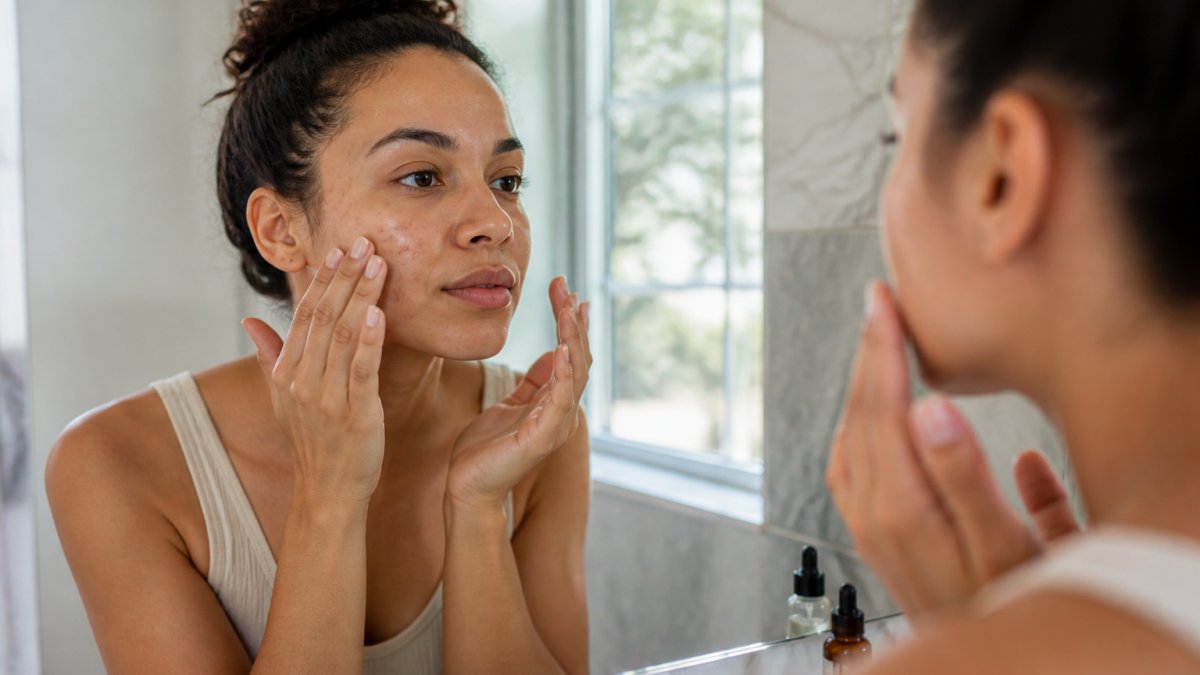
Start simple and add ingredients gradually. Rushing and layering too many actives triggers irritation that worsens PIH. Give each product 2-3 weeks before adding the next, so you can identify what works and avoid overwhelming your barrier.
Safety Guidance for Sensitive Skin and Different Skin Tones
Sensitive skin requires extra caution because irritation deepens post-inflammatory hyperpigmentation. If your skin is reactive, prioritize barrier support over aggressive treatment.
For sensitive skin:
- Skip retinoids initially; start with vitamin C and niacinamide
- Use mandelic acid peels at the lowest concentration (5-10%)
- Limit peels to once weekly until your skin adapts
For deeper skin tones:
- PIH is more visible on darker skin, but it also fades faster with proper treatment
- Be cautious with strong peels (glycolic, salicylic) as they can trigger new PIH if overused
- Mandelic acid is gentler and better-tolerated
Regardless of skin tone, consistency beats intensity. A gentle routine you stick with for 12 weeks outperforms an aggressive routine you abandon after 2 weeks.
If your skin feels tight, hot, or stings after applying a product, you’re using it too frequently or at too high a concentration. Dial back immediately, irritation accelerates PIH, not fades it.
Tracking Progress and Realistic Expectations
Dark spots don’t vanish overnight. Tracking progress keeps you motivated and shows what’s working.
How to monitor fading:
- Take a photo under consistent lighting every 2 weeks (same time of day, same location)
- Compare photos monthly rather than daily (changes are subtle week-to-week)
- Note any changes in darkness, size, or texture of marks
Realistic timelines:
- Mild PIH: 3-6 months with consistent sun protection and topical ingredients
- Moderate PIH: 6-12 months with active treatment
- Severe PIH: 12-24 months; may benefit from professional treatments
Most people see noticeable improvement by 8-12 weeks with consistent sun protection and active ingredients. Complete fading takes longer, but visible lightening happens sooner.
The biggest factor determining success isn’t which product you choose, it’s whether you use sunscreen every single day and stick with your routine for at least 8-12 weeks without switching products constantly.
When to See a Dermatologist
Home care works for most cases of post-inflammatory hyperpigmentation, but some situations warrant professional evaluation.
See a dermatologist if:
- Your dark spots haven’t improved after 6 months of consistent sun protection and topical treatment
- Marks are extremely dark or cover large areas
- You want faster results and are considering professional treatments like laser therapy or chemical peels
Professional treatments accelerate fading significantly. Dermatologists can prescribe stronger retinoids (like tretinoin), perform deeper chemical peels, or recommend lasers that target melanin directly.
According to the American Academy of Dermatology, professional treatments like fractional laser and intense pulsed light (IPL) can fade post-inflammatory hyperpigmentation in 3-5 sessions spaced weeks apart, compared to 6-12 months for at-home care.
For most people, sun protection, gentle cleansing, and topical brightening ingredients resolve PIH completely. The key is starting early, staying consistent, and protecting skin from further UV damage.
Frequently Asked Questions
Can post-inflammatory hyperpigmentation fade on its own without treatment?
Yes, post-inflammatory hyperpigmentation can fade naturally over time, especially with sun protection. Darker skin tones may take 12-24 months or longer for marks to resolve completely. However, active treatment with topical ingredients, sun protection, and professional-grade peels significantly accelerates fading. Without intervention, UV exposure can darken marks and extend the timeline considerably.
What ingredients work best for fading post-inflammatory hyperpigmentation at home?
Vitamin C, niacinamide, azelaic acid, kojic acid, and licorice root extract are evidence-based ingredients that support skin-cell turnover and reduce melanin overproduction. Retinoids and alpha hydroxy acids boost cell turnover to reveal clearer skin underneath. Mandelic acid peels are gentler than glycolic peels and work well for sensitive skin. Layer ingredients gradually to avoid irritation, and always use sunscreen during the day.
How long does it realistically take to see results when treating dark spots at home?
Expect to see subtle improvements within 4-6 weeks of consistent treatment. More noticeable fading typically appears after 8-12 weeks. Deeper or older marks may require 3-6 months or longer. Results depend on mark depth, skin tone, consistency with sun protection, and the active ingredients used. Professional-grade peels accelerate fading compared to topical serums alone.
Is a mandelic acid peel safe for sensitive skin and post-inflammatory hyperpigmentation?
Mandelic acid peels are gentler than glycolic or salicylic peels because the molecule is larger, allowing slower penetration and less irritation. They work effectively on post-inflammatory hyperpigmentation while supporting sensitive skin. Start with lower concentrations (10-15%) and shorter contact times (5-10 minutes), then gradually increase frequency. Always patch-test first and follow with thorough moisturizing and sun protection to maintain your skin barrier.
Post-inflammatory hyperpigmentation fades, but patience and protection accelerate the process. At Makeup Artist’s Choice, we understand the frustration of dark spots lingering after acne clears. Our professional-grade mandelic acid peels and curated brightening routines are designed to fade post-inflammatory hyperpigmentation safely at home. Explore our collection of acid treatments and skincare solutions formulated to deliver visible results without the dermatologist’s office visit.