Table of Contents
- What Type of Acne Scar Are You Actually Treating?
- Best At-Home Peel for Acne Scars: Acids Ranked by Use Case
- Mandelic Acid Peel for Acne Scars: The Sensitive-Skin Option
- How to Use Chemical Peels Safely at Home
- Chemical Peel Recovery Time: What to Expect Week by Week
- Choosing the Right Peel for Your Skin Type and Scar Severity
- When to Stop At-Home Peels and See a Dermatologist
- Conclusion
Last Updated: August 23, 2026
Finding the best at-home peel for acne scars is harder than it looks. The acid aisle is crowded, concentrations are confusing, and the wrong choice can set your skin back weeks. At Makeup Artist’s Choice, we’ve specialized in professional-grade acid treatments since 1997. The honest answer to "Which peel will fade my scars?" is that it depends entirely on what type of scar you’re dealing with. Below, we break down every major acid category, rank them by use case, and give you a step-by-step protocol so you can treat your skin with confidence.
Quick Picks:
- Best for post-inflammatory hyperpigmentation: Glycolic acid peel
- Best for active acne + blackheads: Salicylic acid peel
- Best for deeper atrophic scarring: TCA peel
- Best for sensitive skin: Mandelic acid peel
What Type of Acne Scar Are You Actually Treating?
Most guides skip this step, which is a mistake. Applying the wrong peel to the wrong scar type wastes money and irritates your skin barrier.
Atrophic Scars vs. Post-Inflammatory Hyperpigmentation
Atrophic scars are structural depressions caused by collagen loss during healing. They include ice pick scars, boxcar scars, and rolling scars, sitting below the skin surface and casting shadows.
Post-inflammatory hyperpigmentation (PIH) produces flat, discolored marks left after inflammation resolves. The skin surface is smooth; the problem is pigment, not structure. Many people treat these as scars when they technically are not.
This distinction matters enormously. PIH responds to surface-level epidermal exfoliation. Atrophic scarring requires deeper dermal remodeling to stimulate collagen production in depressed tissue.
Why Scar Type Changes Which Acid You Need
Alpha hydroxy acids like glycolic acid work primarily at the epidermal level, accelerating cellular turnover and fading hyperpigmented macules. Beta hydroxy acids like salicylic acid are oil-soluble and penetrate follicles, making them comedolytic and addressing acne’s root cause. Trichloroacetic acid reaches deeper dermal layers, triggering controlled wound-healing that remodels atrophic scarring. Mandelic acid offers gentler micro-exfoliation with reduced photosensitivity.
Get the scar type wrong, and you solve the wrong problem.
Best At-Home Peel for Acne Scars: Acids Ranked by Use Case
Choosing the right peel comes down to matching the acid’s mechanism to your specific concern.
Glycolic Acid: Best for Surface Texture and Hyperpigmented Macules
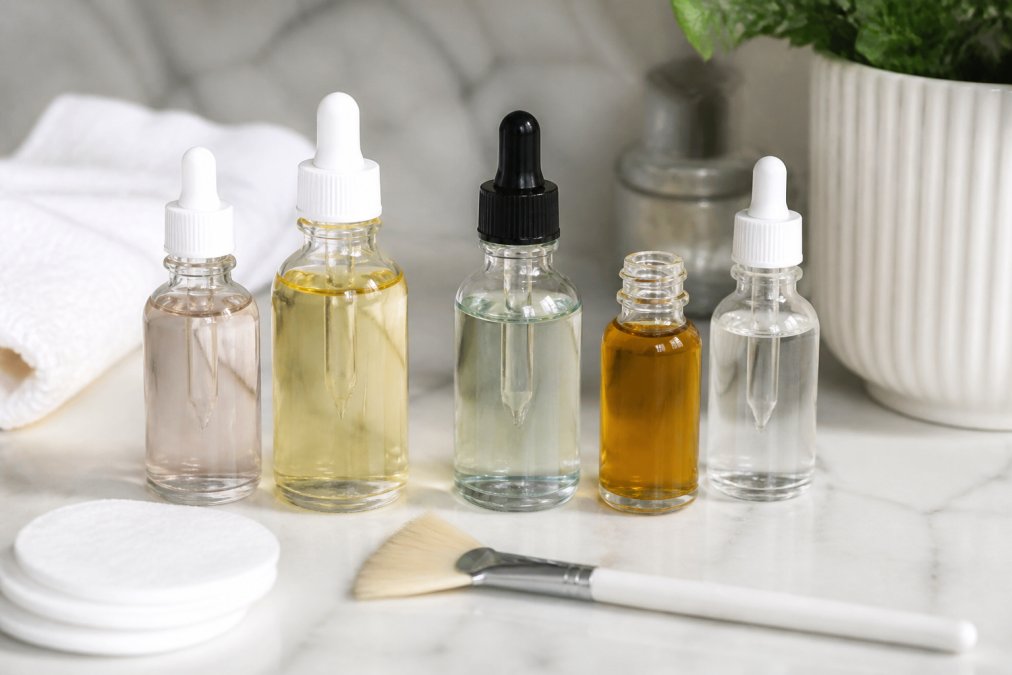
Glycolic acid is the most well-studied alpha hydroxy acid for resurfacing. Its small molecular weight allows efficient epidermal penetration, breaking bonds between dead skin cells and accelerating desquamation. The result is faster cellular turnover, which gradually fades hyperpigmented macules and smooths uneven texture.
For at-home use, concentration matters more than brand. Formulas under 10% are maintenance-level. Formulas between 20-30% at appropriate pH produce meaningful results. Anything above requires professional supervision.
The main limitation: glycolic acid does not reach the dermis at safe at-home concentrations. For true atrophic scarring, it improves texture but cannot remodel structural depressions.
Best for: Post-inflammatory hyperpigmentation, mild surface irregularity, general skin texture improvement.
Salicylic Acid: Best for Active Acne and Comedolytic Action
Salicylic acid is the only beta hydroxy acid widely used in skincare peels. Its oil solubility is the key differentiator. While glycolic acid works on the skin’s surface, salicylic acid dissolves into sebum and works inside the follicle, clearing congestion that leads to breakouts.
This makes salicylic acid the right choice when you experience active acne alongside existing scarring. Treating PIH while new breakouts form is a losing battle. Salicylic acid addresses both: it is comedolytic, preventing comedone formation, and keratolytic, loosening dead skin buildup that traps bacteria.
Concentration range for at-home use is typically 10-20%.
Best for: Oily and acne-prone skin, active breakouts, blackheads and whiteheads alongside PIH.
TCA: Best for Deeper Atrophic Scarring
Trichloroacetic acid is in a different category from AHAs and BHAs. At concentrations used for at-home resurfacing (typically 10-15%), TCA penetrates the dermis and triggers controlled inflammation, stimulating collagen production and dermal remodeling that can raise and soften atrophic scars over time.
The tradeoff is real downtime. Expect erythema, visible peeling, and desquamation for several days. TCA at home requires strict sun avoidance, solid skin barrier repair, and patience across multiple sessions. Structural improvement typically becomes visible after three to six monthly sessions.
Best for: Atrophic scarring, deeper skin texture issues, individuals comfortable with several days of downtime.
| Acid | Scar Type | Depth | At-Home Concentration | Downtime |
|---|---|---|---|---|
| Glycolic acid | PIH, surface texture | Epidermal | 10-30% | Minimal |
| Salicylic acid | Active acne, comedones | Follicular | 10-20% | Minimal |
| TCA | Atrophic scarring | Dermal | 10-15% | 3-7 days |
| Mandelic acid | PIH, sensitive skin | Epidermal | 20-40% | Minimal |
Mandelic Acid Peel for Acne Scars: The Sensitive-Skin Option
Mandelic acid is an alpha hydroxy acid derived from bitter almonds with a larger molecular weight than glycolic acid. That size difference means slower penetration, less irritation, lower erythema risk, and significantly reduced photosensitivity.
For skin that has reacted badly to glycolic acid or trends toward sensitivity, mandelic acid delivers meaningful cellular turnover without triggering barrier response. It is also well-tolerated on darker skin tones, where aggressive acids carry higher risk of causing PIH rather than treating it. professional facial treatments.
The limitation is depth. Mandelic acid stays epidermal, fading hyperpigmented macules and improving texture reliably, but not addressing structural atrophic scarring. It pairs well with salicylic acid in combination formulas for acne-prone skin.
If you have darker skin and are concerned about post-peel PIH, mandelic acid is the safest starting point. Its slower penetration rate dramatically reduces the risk of triggering additional hyperpigmentation during the inflammatory response.
How to Use Chemical Peels Safely at Home
Safe at-home chemical peel use follows a clear protocol. Skipping steps, particularly patch testing and neutralization, is how minor peels become major skin events.
Patch Testing and Contraindications to Know First
Patch testing is non-negotiable before any new peel. Apply a small amount to the inner forearm or behind the ear, wait 24 hours, and check for excessive redness, swelling, or burning beyond mild tingling.
Critical contraindications to review:
- Active retinoid use: Prescription retinoids like tretinoin thin the skin barrier. Using a chemical peel within 5-7 days of retinoid application significantly increases risk of over-exfoliation and barrier damage.
- Accutane (isotretinoin): Chemical peels are contraindicated during treatment and for at least six months after completing a course, as documented in FDA guidance on isotretinoin and skin procedures.
- Open wounds or active cystic acne: Never apply acid to broken skin or active cysts.
- Recent sun exposure: Avoid peeling within 48 hours of significant sun exposure.
- Anticoagulant medications or bleeding disorders: Consult a physician before using TCA.
Step-by-Step Application Protocol
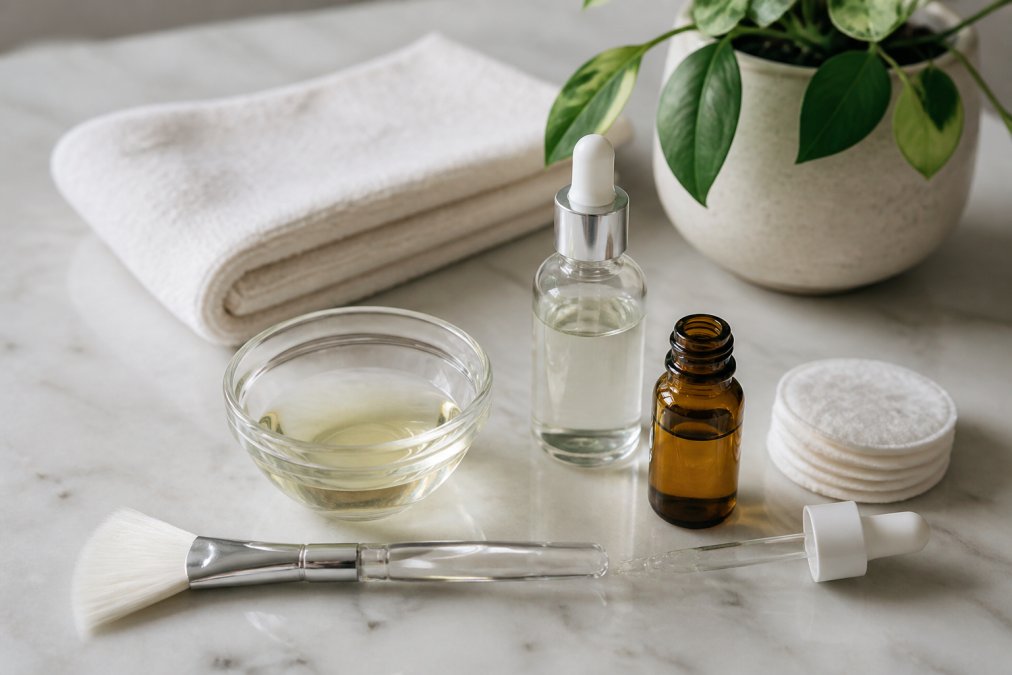
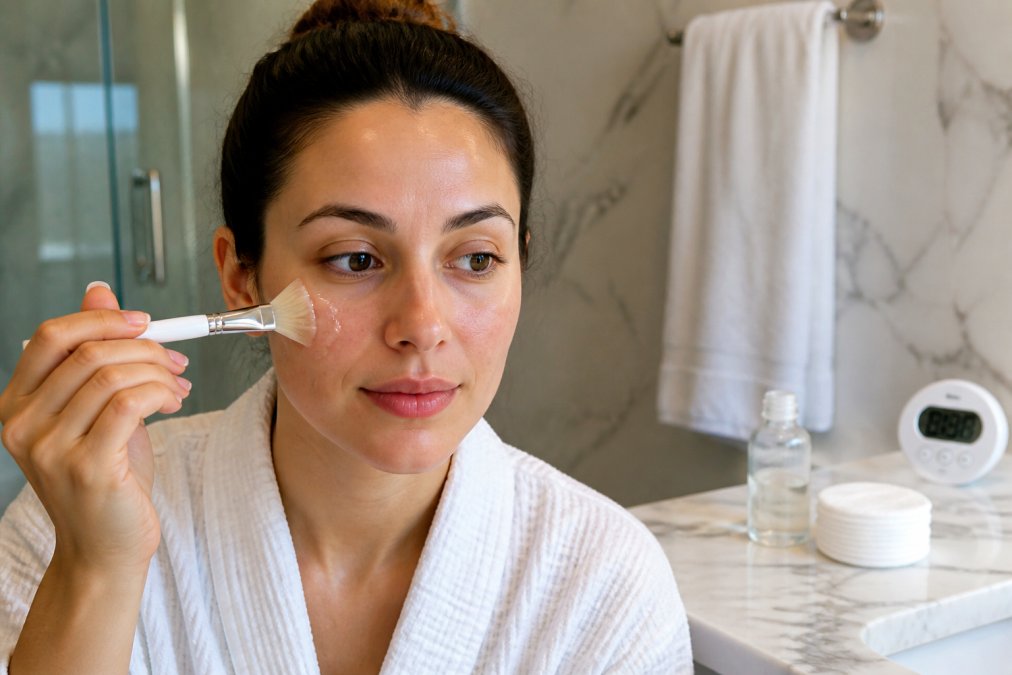
What you’ll need: The peel solution, a fan brush or gauze, a timer, a neutralizing solution (for AHA/TCA peels), a gentle cleanser, and fragrance-free moisturizer.
- Cleanse the skin thoroughly with a gentle, pH-neutral cleanser. Pat dry completely.
- Apply a thin layer of petroleum jelly to the corners of the nose, lips, and eyes to protect sensitive areas.
- Using a fan brush, apply the peel in thin, even strokes starting from the forehead and working downward.
- Set a timer. Do not exceed the recommended contact time. For first sessions, use the lower end of the recommended range.
- Monitor for sensations: mild tingling and warmth are normal. Stinging that escalates or blotchy redness means neutralize immediately.
- Neutralize AHA and TCA peels with a baking soda solution or dedicated neutralizer. Salicylic acid self-neutralizes and is rinsed with cool water.
- Apply fragrance-free, barrier-supporting moisturizer immediately after.
Skin Barrier Repair After Each Session
Post-peel skin barrier repair is where most at-home users fall short. The exfoliation phase is only half the process. Skin barrier integrity determines how well your skin heals and how quickly you can safely peel again.
For the 72 hours following a peel:
- Use only gentle, fragrance-free cleansers
- Apply ceramide-rich moisturizers to support barrier function
- Avoid active ingredients: no retinoids, vitamin C, niacinamide, or additional acids
- Apply broad-spectrum sunscreen with SPF 30 or higher every morning without exception
According to American Academy of Dermatology guidance on chemical peels, sun sensitivity following chemical peels is significantly elevated, and broad-spectrum sunscreen use is essential to prevent new post-inflammatory hyperpigmentation.
Layering multiple active ingredients immediately after a peel is the fastest way to compromise your skin barrier. Stick to the basics: cleanser, moisturizer, sunscreen. Reintroduce actives only after peeling has fully resolved, typically 5-7 days post-treatment.
Chemical Peel Recovery Time: What to Expect Week by Week
Chemical peel recovery time varies by acid type and concentration.
Glycolic and salicylic acid peels (light peels):
- Days 1-2: Mild redness, possible tightness.
- Days 3-5: Subtle flaking, most noticeable around the nose and chin.
- Day 7: Skin typically fully recovered and visibly brighter.
TCA peels (medium-depth):
- Days 1-2: Erythema, swelling, and skin tightness.
- Days 3-5: Visible peeling begins. Skin may appear brown and leathery before shedding.
- Days 5-7: Active desquamation. Do not pick or peel manually.
- Day 10-14: New skin fully revealed. Redness may persist for several weeks.
- Months 1-6: Continued dermal remodeling and collagen production.
A single TCA session does not produce dramatic results. Structural improvement accumulates across three to six monthly sessions, with full results visible at the six-month mark.
Chemical peel recovery time is not just about visible peeling. Dermal remodeling from TCA continues for weeks after the surface has healed. Patience between sessions is part of the treatment protocol.
Choosing the Right Peel for Your Skin Type and Scar Severity
Matching peel strength to skin type is the decision most people get wrong. The instinct is to go stronger, faster. The reality is that mismatched intensity sets the skin back rather than forward.
A practical framework for choosing a peel for acne scars:
- Oily, acne-prone skin with PIH and active breakouts: Start with salicylic acid at 10-15%. Address active acne first, then assess remaining pigmentation.
- Dry or combination skin with PIH: Glycolic acid at 20-30% is effective. Ensure skin is well-hydrated before each session.
- Sensitive skin or darker skin tones: Mandelic acid is the appropriate starting point. Build tolerance before considering glycolic.
- Mild to moderate atrophic scarring: TCA at 10-12.5% used monthly over three to six sessions.
- Severe atrophic scarring: At-home peels will improve but not resolve deep structural scarring. Dermatological consultation is warranted.
As noted in [National Institutes of Health research on chemical peels(/product-tag/at-home-chemical-peels/) and skin resurfacing | nih.gov], the concentration and formulation of the peeling agent, combined with the individual’s skin type and condition, are the primary determinants of outcome and risk.
Makeup Artist’s Choice offers professional-grade formulas across glycolic, salicylic, and TCA categories, made in the USA and formulated for at-home use. The range allows you to start conservatively and progress as your skin builds tolerance.
When to Stop At-Home Peels and See a Dermatologist
At-home chemical peels are effective for a defined range of skin concerns. Knowing the boundary of that range is as important as knowing the protocol.
Stop at-home peeling and seek dermatological consultation if:
- Scarring is deep and structural: Ice pick scars and severe boxcar scars require procedures like subcision, microneedling with radiofrequency, or professional-depth TCA cross technique.
- You develop unexpected reactions: Prolonged erythema beyond two weeks, blistering, worsening hyperpigmentation, or signs of infection require professional evaluation.
- You are on prescription acne medications: Contraindications with active acne medications, particularly isotretinoin and high-dose retinoids, require a physician’s guidance.
- PIH is not responding after four to six sessions: Stubborn pigmentation may require prescription-strength hydroquinone, azelaic acid, or laser treatment.
- You have a history of keloid scarring: Chemical peels carry a risk of triggering keloid formation in susceptible individuals. A board-certified dermatologist should assess risk before any resurfacing treatment.
The [American Academy of Dermatology’s guidance on acne scarring(/collections/scars/) treatments | aad.org] outlines when professional intervention is necessary. At-home peels are a genuine, cost-effective tool for managing PIH and mild-to-moderate atrophic scarring, but not a substitute for clinical intervention when severity warrants it.
Acne scarring is one of the most persistent skin concerns to treat, and the overwhelming number of products and acids on the market makes the decision harder than it needs to be. Makeup Artist’s Choice has been formulating professional-grade acid treatments since 1997, with a range that covers glycolic, salicylic, lactic, and TCA peels designed specifically for at-home use. Whether you are starting with a gentle mandelic acid peel for sensitive skin or working up to TCA for deeper atrophic resurfacing, the right formula exists. Shop Makeup Artist’s Choice to find the peel for acne scars matched to your skin type and scar severity.
Frequently Asked Questions
Q: Can at-home chemical peels actually get rid of acne scars?
A: At-home peels can meaningfully reduce the appearance of acne scars, particularly post-inflammatory hyperpigmentation and shallow atrophic scarring. Acids like glycolic, salicylic, and trichloroacetic acid work by accelerating cellular turnover and stimulating collagen production over repeated sessions. Deep ice-pick or boxcar scars require professional resurfacing. Consistent use over several weeks is typically needed before visible improvement in skin texture and hyperpigmented macules becomes clear.
Q: Which acid is best for hyperpigmentation and acne scarring?
A: Glycolic acid is the most studied alpha hydroxy acid for post-inflammatory hyperpigmentation because it accelerates epidermal exfoliation and speeds up cellular turnover. Salicylic acid is the preferred beta hydroxy acid for oily or acne-prone skin due to its comedolytic properties. Mandelic acid works well for darker skin tones where other acids risk causing irritation or uneven pigmentation. TCA targets deeper dermal remodeling for atrophic scarring. The best choice depends on your scar type and skin tone.
Q: How often should you use a chemical peel for acne scars?
A: For most at-home peels, once every one to two weeks is the standard starting frequency. Beginners should start at the lower end and monitor for excessive erythema or prolonged desquamation before increasing frequency. TCA peels are stronger and typically used once every four to six weeks. Consistent spacing allows the skin barrier to recover fully between sessions, which protects against over-exfoliation and maintains skin barrier integrity throughout the treatment course.
Q: What are the safety precautions for using professional-grade peels at home?
A: Always patch test 48 hours before full application. Avoid using peels alongside retinoids, benzoyl peroxide, or other active exfoliants on the same day, as combining these increases the risk of barrier damage. Neutralize acid peels as directed and never exceed the recommended contact time. Apply broad-spectrum sunscreen daily, since photosensitivity increases significantly after any acid treatment. Anyone using prescription acne medications like isotretinoin should consult a dermatologist before starting chemical peels.
Q: How long does chemical peel recovery time take at home?
A: Recovery time depends on peel strength. Superficial peels using low-concentration glycolic or salicylic acid typically cause mild redness and light flaking for two to four days. Medium-depth peels, including higher-concentration TCA, may produce visible peeling and erythema for five to seven days. Downtime is generally shorter with at-home formulas than professional-strength treatments. Skin barrier repair products, including ceramide-rich moisturizers, should be used throughout recovery to support healing.
This article was written using GrandRanker