Table of Contents
- Why Deep Icepick Scars Are Difficult to Treat at Home
- Understanding Atrophic Scars: Types and Depth
- How to Use TCA Peel at Home for Scar Reduction
- Mandelic Acid Peel: A Gentler Alternative for Textured Skin
- The Role of Exfoliation and Retinoids in Collagen Production
- How Long to See Results From Chemical Peels
- Safety Precautions and When to Consult a Dermatologist
- Your Daily Skincare Routine for Pitted Scarring
- Frequently Asked Questions
Last Updated: September 26, 2026
Why Deep Icepick Scars Are Difficult to Treat at Home
Deep icepick acne scars are notoriously resistant to at-home treatment because of their structure. Unlike rolling or boxcar scars that sit closer to the skin surface, icepick scars are narrow, deep indentations that penetrate far into the dermis. This depth makes them mechanically difficult for topical products to address effectively.
Topical treatments work only in the epidermis and upper dermis, while icepick scars extend far deeper. Even potent ingredients like retinoids and niacinamide cannot rebuild collagen deep enough to fill a true icepick scar, though they improve texture and reduce hyperpigmentation.
Chemical peels trigger collagen production at greater depths by removing skin layers. The trade-off: higher risk, longer recovery, and need for precise application. Understanding this helps you set realistic expectations.
Many people expect topical treatments to fade deep icepick scars within weeks. Deep structural scarring requires months of consistent treatment, and even then, results are often modest without professional intervention like microneedling or laser therapy.
Understanding Atrophic Scars: Types and Depth
Atrophic scars form when skin loses collagen during healing. Their depth, width, and shape determine treatment response.
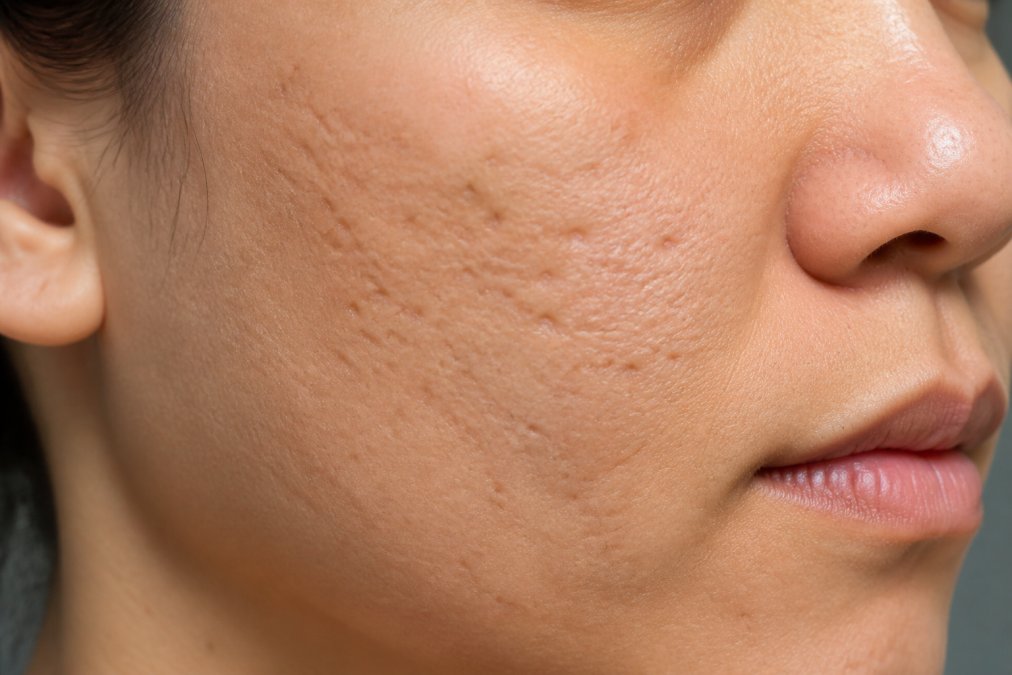
Icepick scars are the deepest and narrowest type, resembling puncture wounds that extend into the subcutaneous layer. Their narrow width and depth make them most resistant to topical treatments and often require professional resurfacing or dermal fillers.
Boxcar scars are wider and shallower with sharply defined edges, sitting higher in the dermis and responding better to chemical peels and exfoliation.
Rolling scars have sloping edges and wave-like appearance, responding best to at-home treatments since they involve elasticity loss rather than deep structural damage.
Scar depth determines which treatments work, a peel strong enough for icepick scars may be too aggressive for rolling scars, making scar type assessment essential.
Icepick scars are the most challenging type to treat at home because they extend deepest into the skin. Boxcar and rolling scars respond better to topical and exfoliating treatments, but icepick scars often require professional intervention for visible results.
How to Use TCA Peel at Home for Scar Reduction
TCA (trichloroacetic acid) peels are among the most effective at-home chemical treatments for how to fade deep icepick acne scars at home, but demand careful technique. TCA denatures skin proteins, triggering controlled injury that stimulates collagen production and dermal remodeling.
Typical TCA peels for scars use 15-30% concentrations. Stronger peels penetrate deeper but increase risk of scarring, hyperpigmentation, and redness. Start with 15-20% and increase only after assessing skin response.
Apply TCA evenly with a cotton swab or brush, working quickly in thin layers. The “TCA cross” technique applies TCA directly into scar pits to maximize collagen stimulation but is more aggressive and carries higher risk if not executed precisely.
Recovery involves 5-7 days of peeling, redness, and potential swelling. Strict sun protection (SPF 50+) is mandatory, TCA-treated skin is vulnerable to hyperpigmentation from UV exposure.
TCA cross carries a real risk of permanent scarring or hypopigmentation if applied too strong, too long, or to the wrong depth. If you’re treating icepick scars with TCA, start conservatively. Stronger is not always better, and mistakes are difficult to reverse.
Mandelic Acid Peel: A Gentler Alternative for Textured Skin
Mandelic acid is an AHA derived from bitter almonds with a larger molecular size than glycolic acid, penetrating more slowly and causing less irritation. This makes it an excellent option for gentler chemical treatments addressing pitted scarring and skin texture.
Mandelic acid dissolves bonds between dead skin cells, promoting epidermal turnover and collagen production in the upper dermis. While less aggressive than TCA for deep icepick scars, it’s more forgiving for beginners and sensitive skin.
Typical mandelic acid peels use 10-20% concentrations for 10-15 minutes. Recovery is minimal, mild redness and light peeling for 2-3 days versus TCA’s week-long downtime, making it easier to incorporate into regular routines.
Mandelic acid primarily addresses the epidermis and upper dermis, making it better for post-inflammatory hyperpigmentation and shallow scars than deep icepick scars. For severe structural scarring, it may not deliver desired results alone, but it’s an excellent maintenance tool.
Makeup Artist’s Choice formulates mandelic acid peels for at-home use, balancing efficacy with safety for beginners, allowing you to assess tolerance before moving to stronger options.
The Role of Exfoliation and Retinoids in Collagen Production
Exfoliation and retinoid use create the foundation for scar-fading regimens. While neither restructures deep icepick scars alone, they work synergistically to improve texture, boost collagen, and prepare skin for stronger treatments.
Exfoliation removes dead skin cells, allowing active ingredients to penetrate effectively. Chemical exfoliants (AHAs and BHAs) are superior to physical scrubs for scarred skin. Regular exfoliation 2-3 times weekly triggers epidermal turnover and stimulates collagen-producing fibroblasts.
Retinoids are vitamin A derivatives that increase cell turnover and collagen synthesis. They bind to cellular receptors, signaling skin to produce more collagen and elastin, leading to measurable improvements in texture and shallow scarring over months.
The combination of regular exfoliation and retinoid use creates a feedback loop: exfoliation removes the barrier to absorption, retinoids stimulate deeper collagen production, and the result is gradual improvement in skin firmness and texture. For pitted scarring, this dual approach addresses both the surface (exfoliation) and the deeper layers (retinoids).
Start retinoids at a low concentration (0.025% retinol or retinol equivalent) and increase gradually over 8-12 weeks. Retinoids can cause irritation, dryness, and increased sun sensitivity, so introduce them slowly and always pair them with broad-spectrum sunscreen.
How Long to See Results From Chemical Peels
Patience is critical when using chemical peels to fade deep icepick acne scars at home. Results don’t appear overnight, and expecting dramatic changes within weeks will lead to disappointment.
For mandelic acid peels, most people notice subtle improvements in skin texture and tone within 2-4 weeks of weekly treatments. Post-inflammatory hyperpigmentation typically fades faster than structural scarring. True collagen remodeling, the process that actually reduces scar depth, takes 8-12 weeks to become visible.
TCA peels work more aggressively, so results appear faster. Many people see noticeable improvement in scar depth and overall skin texture within 4-6 weeks of monthly treatments. However, the full effect of collagen remodeling continues for 3-6 months after each peel.
The timeline depends on several factors: the depth of your scars, the strength of the peel you’re using, how frequently you treat, your age (younger skin heals faster and produces collagen more readily), and your genetic predisposition to scarring. Someone with shallow rolling scars might see dramatic results in 8 weeks; someone with deep icepick scars might need 6+ months of consistent treatment to see modest improvement.
| Treatment Type | Typical Timeline | Frequency | Expected Improvement |
|---|---|---|---|
| Mandelic Acid Peel | 8-12 weeks | Weekly or bi-weekly | Modest texture improvement, fades hyperpigmentation |
| TCA Peel (15-20%) | 4-6 weeks | Monthly | Visible scar depth reduction for shallow to moderate scars |
| Retinoid + Exfoliation | 12-16 weeks | Daily/2-3x weekly | Gradual texture improvement, supports collagen |
Consistency matters more than strength. A gentle peel used weekly will outperform an aggressive peel used sporadically. Your skin needs regular stimulation to maintain collagen production and epidermal turnover.
Track your progress with photos taken in the same lighting and angle every 4 weeks. Subtle improvements are hard to notice day-to-day but become obvious when you compare images over months.
Safety Precautions and When to Consult a Dermatologist
Chemical peels carry real risks if applied incorrectly. Before starting any at-home peel regimen, understand what can go wrong and how to prevent it.
Hyperpigmentation is the most common complication, especially in people with darker skin tones. It occurs when the peel triggers excess melanin production during healing. Prevent it by using strict sun protection (SPF 50+, reapplied every 2 hours) and avoiding sun exposure for at least 2 weeks post-peel.
Hypopigmentation (permanent lightening of the skin) is rarer but more serious. It’s caused by over-treatment or using a peel that’s too strong for your skin type. This risk increases significantly with TCA peels above 25% concentration. Once hypopigmentation occurs, it’s often permanent.
Scarring from the peel itself can happen if you apply TCA too strong or leave it on too long.
You should consult a dermatologist before starting at-home chemical peels if:
- You have a history of keloid or hypertrophic scarring
- You have active acne or open wounds
- You’re pregnant or breastfeeding
- You have darker skin and are concerned about hyperpigmentation
- Your scars are very deep or you’ve had previous professional treatments that didn’t work
- You’re taking medications that increase sun sensitivity (like retinoids or certain antibiotics)
- You’re unsure about your scar type or the appropriate peel strength
Your Daily Skincare Routine for Pitted Scarring
Consistency in your daily routine determines whether peels and treatments actually work. The days between chemical treatments matter as much as the treatments themselves.
Frequently Asked Questions
What is the hardest acne scar to get rid of?
Icepick scars are the most challenging acne scars to fade because they’re narrow, deep punctures that extend far into the dermis. Unlike boxcar or rolling scars, their concentrated depth makes topical treatments struggle to reach the scar tissue. Professional treatments like laser therapy or dermal fillers often work better than at-home methods for severe icepick scars, though consistent chemical peels and microneedling can improve their appearance over time.
Can retinol fix icepick scars?
Retinol helps improve skin texture and can fade post-inflammatory hyperpigmentation, but it cannot structurally fill deep icepick scars on its own. Retinoids work by increasing epidermal turnover and stimulating collagen production, which gradually improves skin quality. For icepick scars, retinol works best as part of a multi-step approach that includes chemical peels or professional treatments that directly address the scar’s depth.
How long to see results from chemical peels for acne scars?
Most people notice visible improvement in skin texture and hyperpigmentation within 4-6 weeks of starting regular chemical peels. However, structural improvement in icepick scar depth typically takes 8-12 weeks of consistent monthly treatments. Results depend on peel strength, frequency, and scar severity. Mandelic acid peels show gentler, gradual results, while TCA peels may produce faster changes but require longer recovery between applications.
What fades acne scars quickly?
Professional treatments like laser resurfacing and microneedling produce faster visible results than at-home options, often showing improvement in 2-3 sessions. At home, chemical peels, especially TCA peels, combined with retinoids and niacinamide can fade scars more quickly than topicals alone. Consistency matters more than speed; monthly chemical peel treatments combined with daily retinoid use typically outperform sporadic single treatments.