Quick Summary
Avoid fragrance and essential oils, drying alcohols like alcohol denat., harsh sulfate cleansers, formaldehyde-releasing preservatives, and strong actives used at high strength when treating sensitive skin with hyperpigmentation. Irritation can trigger post-inflammatory hyperpigmentation, so choose gentle, fragrance-free products and introduce actives one at a time.
- Choose fragrance-free products, since “parfum” can hide dozens of scent compounds.
- Avoid volatile alcohols like alcohol denat. and SD alcohol, which strip the skin barrier.
- Watch for formaldehyde releasers and methylisothiazolinone, which are linked to contact allergy.
- Introduce strong actives one at a time, at the lowest effective strength.
- Patch test new products for 72 hours before applying them to your face.
Table of Contents
- Why Irritation Makes Hyperpigmentation Worse
- Skincare Ingredients to Avoid for Sensitive Skin
- Irritation Versus Allergy: Knowing What Your Skin Is Telling You
- Best Ingredients for Sensitive Skin and Dark Spots
- How to Treat Hyperpigmentation on Sensitive Skin
- Patch Testing Skincare Products Before You Commit
- Building a Safer Routine for Your Next Step
- Frequently Asked Questions
Why Irritation Makes Hyperpigmentation Worse
Last Updated: October 29, 2026
Dark spots are often the aftermath of inflammation. When your skin gets irritated, it can respond by producing extra melanin, the pigment that gives skin its color.
This is why ingredient choice matters so much. A gentle routine can make a real difference for people working on uneven tone.
Irritation can come from many sources:
- Fragrance and essential oils
- Drying alcohols
- Harsh cleansers
The key point: Calm skin heals more evenly. Reactive skin tends to hold on to pigment.
Skincare Ingredients to Avoid for Sensitive Skin
Not every ingredient affects every person the same way. An ingredient is not universally harmful; it is a problem for some skin types, in some formulations, at some concentrations. Still, a handful of ingredient families show up again and again in reports of irritation, and for skin prone to post-inflammatory hyperpigmentation, each reaction carries a higher cost: a bout of redness or stinging can leave a mark that outlasts the product that caused it.
Use the list below as a screening tool, not a ban list.
Fragrance, Parfum and Essential Oils
Fragrance is one of the most frequently reported causes of cosmetic contact dermatitis (the NIH). The word “parfum” or “fragrance” on a label can stand in for a mixture of dozens of scent compounds, and you cannot tell from the label which ones are present.
Two label traps matter here. First, “unscented” is not the same as “fragrance-free”: an unscented product may contain a masking fragrance to neutralize the smell of raw materials. Second, “natural” fragrance is not automatically gentler; essential oils are among the most common essential-oil-related irritants and allergens in skincare.
For reactive skin, fragrance-free is the safer default, especially in leave-on products like serums and moisturizers. Rinse-off products are lower risk because contact time is short, but if your skin is actively inflamed, minimize fragrance across the routine.
Drying Alcohols, Sulfates and Harsh Cleansers
Not all alcohols are drying. Fatty alcohols such as cetyl, stearyl, and cetearyl alcohol are emollients.
Sulfates are strong surfactants. Sodium lauryl sulfate (SLS) is the classic example and is well documented as a skin irritant in patch-test and cumulative-irritation studies; sodium laureth sulfate (SLES) is generally milder but still cleansing enough to strip dry or reactive skin.
The practical rule: a cleanser should leave skin comfortable, not squeaky. If your face feels tight after washing, the cleanser is doing too much.
Formaldehyde-Releasing Preservatives and Methylisothiazolinone
Preservatives are necessary; an unpreserved water-based product is a microbial risk. The issue is which preservatives, and at what concentration.
Formaldehyde releasers include DMDM hydantoin, diazolidinyl urea, imidazolidinyl urea, quaternium-15, and bronopol. In the U.S., the FDA regulates cosmetics but does not pre-approve ingredients, so reading the label is your main line of defense (the FDA).
If you notice recurring redness, itching, or a rash that appears in the same place each time you use a product, these preservatives are worth checking first.
Harsh or Potentially Irritating Actives
Strong actives are not “bad” ingredients, but they are dose- and frequency-dependent, and they are the most common cause of the irritation that drives post-inflammatory hyperpigmentation in people who are actively treating dark spots.
- Alpha-hydroxy acids (AHAs): glycolic acid has the smallest molecule and penetrates fastest, which makes it the most likely to sting; lactic acid is somewhat gentler; mandelic acid has a larger molecule and is often better tolerated, though concentration and pH still determine how much it exfoliates.
- Beta-hydroxy acid (BHA): salicylic acid is oil-soluble and useful for congestion, but it can dry out reactive skin, especially at higher percentages or in leave-on formats.
- Retinoids: retinol, retinal, and prescription tretinoin all accelerate cell turnover and commonly cause redness, flaking, and stinging during the adjustment period.
The takeaway is not to avoid these ingredients forever. It is to introduce one at a time, at the lowest effective strength, and to back off if irritation appears.
Colorants, Dyes and Coal Tar Dyes
Synthetic colorants (often listed as CI numbers, such as CI 19140 or CI 16035) and coal tar dyes are added for appearance, not function. They are not common irritants in the way fragrance is, but some people react to specific dyes, and coal tar dyes have a longer history of concern. In leave-on products for reactive skin, simpler is usually better; colorants add exposure without adding benefit.
What This Means for Hyperpigmentation
Every ingredient above is a potential source of low-grade inflammation. For skin that produces excess pigment after injury, that inflammation is the mechanism behind new dark spots. Screening these ingredient families out of your routine is not about purity; it is about reducing the number of chances your skin has to react.
The article groups the main irritant families and the label traps that go with them.
| Ingredient family | Why it irritates | Safer choice |
|---|---|---|
| Fragrance and essential oils | Common cause of contact dermatitis; hidden in “parfum” | Fragrance-free products |
| Volatile alcohols (alcohol denat., SD alcohol) | Strip lipids and weaken the barrier | Fatty alcohols such as cetyl or stearyl alcohol |
| Sulfates (SLS, SLES) | Strong surfactants that strip dry or reactive skin | Milder surfactants like glucosides or amino acid-based agents |
| Formaldehyde releasers and MI/MCI | Associated with contact allergy and sensitization | Read labels and check these first if rashes recur |
| Strong actives (glycolic acid, retinoids, benzoyl peroxide) | Dose- and frequency-dependent irritation | Lowest effective strength, introduced one at a time |
Irritation Versus Allergy: Knowing What Your Skin Is Telling You
Irritation and allergy can look alike, but they are different. Irritation usually causes burning, stinging, or dryness soon after application. An allergic reaction, or contact dermatitis, often shows up as itchy, raised, or bumpy skin, sometimes a day or more later.
Knowing the difference helps you act. If a product burns for a few minutes and settles, it may simply be too strong for your skin right now.
Best Ingredients for Sensitive Skin and Dark Spots
Gentler ingredients can still help with tone. Many people with reactive skin do well with niacinamide, azelaic acid, and low-strength vitamin C. Mandelic acid is often considered a milder exfoliating acid, though strength and frequency still matter.
Start slowly. If you are weighing a brightening serum, read how to choose a vitamin C serum for hyperpigmentation before you buy. Some people also ask whether mandelic acid is gentle enough for sensitive skin, and that answer depends on your skin’s history.
How to Treat Hyperpigmentation on Sensitive Skin
Treatment works best when you protect the skin barrier first. Use a gentle cleanser, a simple moisturizer, and daily sunscreen. Sun exposure can darken existing spots, so sunscreen is not optional.
Professional options exist, but they carry their own risks for sensitive skin. Before trying any peel, learn how to avoid chemical peel skin damage. If you are ready to browse products made for fading dark spots, see the hyperpigmentation collection from Makeup Artist’s Choice.
Watch out: Layering several strong actives at once is a common way to trigger new dark spots. Introduce one at a time.
Patch Testing Skincare Products Before You Commit
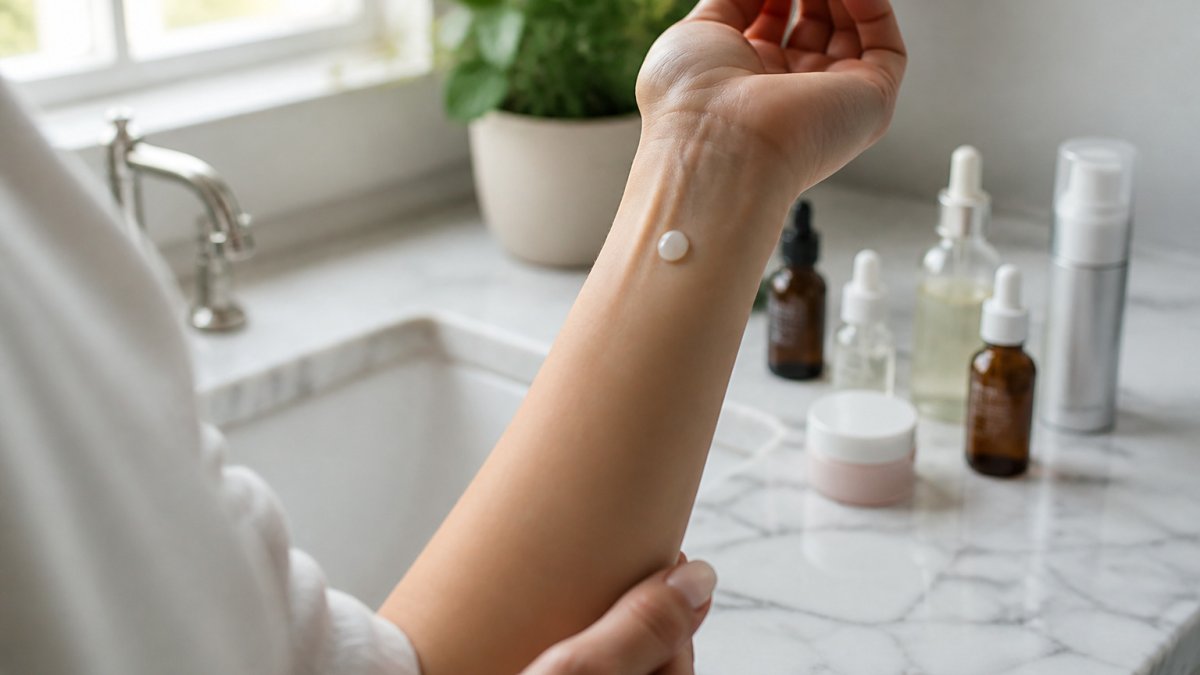
Patch testing is the simplest way to protect yourself, and for skin prone to hyperpigmentation it is more than a convenience. A reaction that would be a few days of redness on another person can leave a mark that lasts months on yours. Testing before you commit is how you keep a new product from becoming a new dark spot.
A Practical Patch-Test Protocol
- Choose a discreet test site. The inner forearm or behind the ear is standard. If you are testing a facial product, the side of the neck or the jawline just below the ear is a reasonable middle ground, because facial skin can be more reactive than forearm skin.
- Apply a small amount, roughly the size of a pea, to a clean, dry area. Do not rub it in aggressively; apply it the way you would on your face.
- Leave it undisturbed for 24 hours if you can, then wash gently. Check the site at 24, 48, and 72 hours, and again at about five days. Some allergic reactions are delayed and will not show up on day one.
- Watch for specific signs: redness, itching, stinging, burning, swelling, or a raised, bumpy rash. Note the timing. Burning or stinging within minutes that fades is more consistent with irritation; itching, swelling, or a rash that appears a day or more later is more consistent with an allergic response.
- Only move to the face after the test site stays calm for the full observation period. When you do, introduce the product on a small area of the face first and use it every other day for the first week.
Introduce One Product at a Time
The most common mistake is starting several new products in the same week. If a reaction appears, you will not know which product caused it, and you may end up avoiding ingredients you tolerate fine.
This matters more when you are treating pigmentation, because the products most likely to help, retinoids, acids, brightening serums, are also the ones most likely to irritate.
When to Stop and Seek Help
Stop using the product and contact a healthcare professional if you develop spreading redness, swelling, blisters, or a rash that does not settle within a few days. The FDA’s guidance on cosmetic reactions is a useful starting point for understanding when a reaction warrants medical attention. If you have reacted to several products, a dermatologist can arrange patch testing with a standardized allergen series to identify the specific ingredient responsible, which is more reliable than trial and error.
Keep a simple product log: the product name, the date you started, and any reaction. Patterns across products often point to a shared ingredient, fragrance, a preservative, or a specific active, faster than memory will.
Patch Testing Is Not a Guarantee
A negative patch test reduces risk; it does not eliminate it. Reactions can depend on concentration, how often you apply the product, whether your barrier is already compromised, and what else is in your routine. If your skin is currently irritated, wait until it is calm before testing anything new, because a reactive barrier will give you a false positive on a product that might be fine once your skin recovers.
Building a Safer Routine for Your Next Step
Choose one new product at a time, and keep your routine simple. Patch test first, use sunscreen daily, and stop any product that causes persistent irritation. If you want a clear next step, read whether a daily sunscreen routine is safe for acne-prone skin before adding it to your regimen. Shop our products when you are ready to build a routine that suits your skin.
Frequently Asked Questions
What is the best ingredient for hyperpigmentation on sensitive skin?
For sensitive skin, gentler options such as azelaic acid, niacinamide and low-concentration lactic acid are commonly used to address dark spots without heavy irritation. Start with one product at a time, introduce it slowly, and watch for redness or stinging. Stronger actives like glycolic acid or hydroquinone should only be used under guidance from a dermatologist, since irritation itself can trigger post-inflammatory hyperpigmentation and make dark spots darker.
Can skin irritation make hyperpigmentation worse?
Yes. When skin becomes inflamed from harsh products, rubbing, or sun exposure, melanocytes can overproduce pigment during healing, a process called post-inflammatory hyperpigmentation. This is why avoiding irritants matters as much as choosing active treatments. If a product causes burning, itching, or persistent redness, stop using it and reassess, because continued irritation can deepen existing marks.
Which exfoliating acids are too harsh for sensitive skin?
High-concentration glycolic acid, strong salicylic acid formulas and TCA peels are the most likely to irritate sensitive skin. Lower-concentration lactic or mandelic acid is usually better tolerated. Concentration, pH and frequency all matter, so a product labeled as mild can still be too strong if used daily. Introduce any exfoliant gradually, starting one to two nights per week, and keep sun protection consistent.
How do I know if a product is causing irritation or an allergy?
Irritation usually appears quickly, within minutes to hours, and feels like stinging, burning or tightness, while allergic contact dermatitis often takes 24 to 72 hours to show as itching, bumps or spreading redness. Irritation can affect anyone at high enough exposure, whereas allergy is an immune response to a specific ingredient. If symptoms are severe, blistering or spreading, contact a healthcare provider.