Last Updated: November 6, 2026
Quick Summary
Is niacinamide effective for acne scars? Niacinamide helps flat dark and red marks fade, but it cannot rebuild indented or raised scar tissue. It lightens the look of flat marks by interfering with melanin transfer, while textural scars need resurfacing procedures instead.
- Stretch skin between two fingers: marks that flatten are discoloration, marks that stay dented are textural scars.
- A 5% concentration is the sweet spot for most people; higher percentages raise irritation risk without working better.
- Expect first visible changes in four to eight weeks, with more obvious fading over three to six months.
- After a peel, wait until days 4-7 and skin feels calm before reintroducing niacinamide once daily.
- Patch test behind the ear or inner forearm for 2-3 days before applying niacinamide to your face.
Table of Contents
- What Niacinamide Can and Cannot Do for Acne Scars
- Niacinamide for Post-Acne Marks: PIH, PIE, and Dark Spots
- Niacinamide Percentage for Acne: How to Pick a Strength
- How Long Does Niacinamide Take to Work on Acne Marks?
- What the Clinical Evidence Says About Niacinamide and Scars
- Chemical Peel Aftercare for Acne Marks: Where Niacinamide Fits
- Build a Niacinamide Routine for Acne Marks and Textural Scars
- Choosing the Right At-Home Peel to Pair With Niacinamide
- Frequently Asked Questions
What Niacinamide Can and Cannot Do for Acne Scars
Is niacinamide effective for acne scars? The honest answer is that niacinamide helps flat dark and red marks fade, but it cannot rebuild indented or raised scar tissue. That single distinction decides whether the ingredient belongs in your routine. This is one of the most common questions about post-acne discoloration.
Niacinamide is a form of vitamin B3 that supports the skin barrier and interferes with how pigment reaches the skin’s surface.
Here is the practical split:
- What it helps: dark spots, brown marks, red marks, uneven skin tone, oiliness, and mild inflammation
- What it cannot do: fill indented scars, flatten raised scars, or resurface pitted texture
- What it can support: barrier repair and hydration while stronger treatments do the resurfacing work
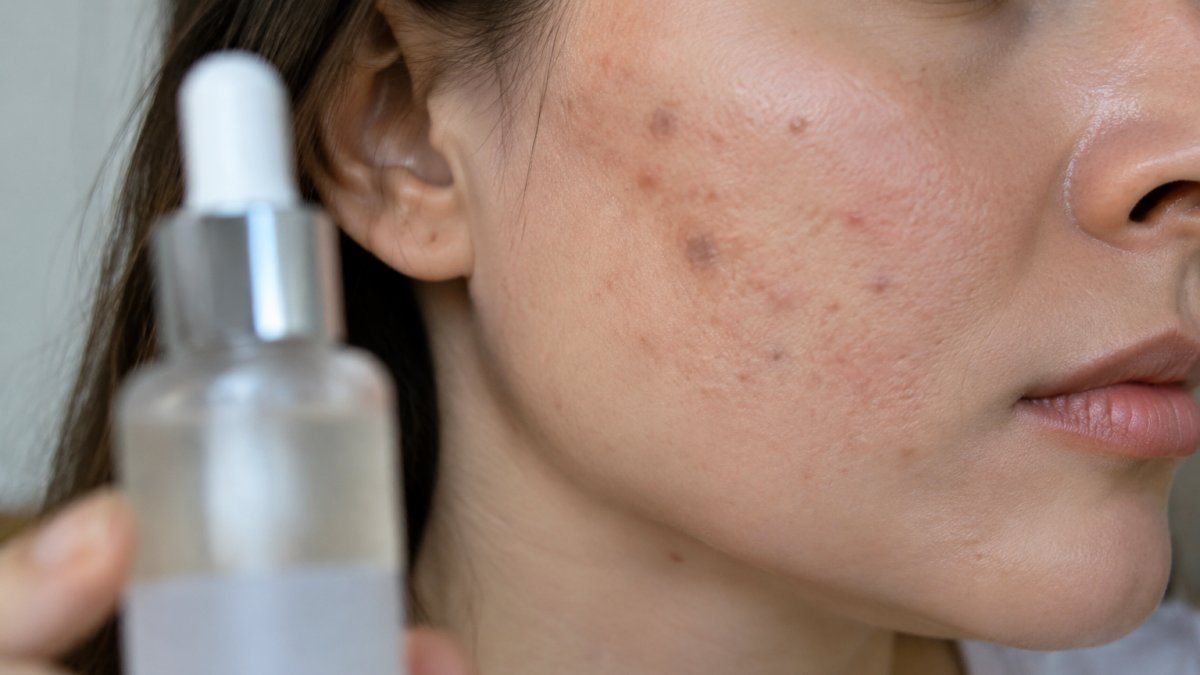
Flat Marks vs. Textural Scars: How to Tell Them Apart
Stretch your skin gently between two fingers and look in a mirror. If the mark disappears or flattens, it is discoloration. If a dent or ridge stays visible, it is a textural scar.
That test matters because the two need different plans:
- Flat marks sit level with the skin and are driven by pigment or blood vessels
- Atrophic scars are indented, including ice pick, boxcar, and rolling types (the American Academy of Dermatology)
- Raised scars sit above the surface and involve excess collagen
Niacinamide is a reasonable tool for the first group and a poor one for the other two. If you are unsure which you have, our guide on acne scars vs hyperpigmentation walks through the visual differences in detail.
Niacinamide for Post-Acne Marks: PIH, PIE, and Dark Spots
Niacinamide for post-acne marks works best on two specific types: post-inflammatory hyperpigmentation and post-inflammatory erythema.
Post-inflammatory hyperpigmentation, or PIH, is a flat brown or tan mark left after a breakout heals. It happens when inflammation pushes melanin production into overdrive.
Post-inflammatory erythema, or PIE, is a flat red or pink mark caused by dilated blood vessels and lingering inflammation. Niacinamide’s anti-inflammatory action can help calm the redness over time.
Dark spots on deeper skin tones often fall into the PIH category and tend to fade slowly without help. For a fuller breakdown of fading strategies, see our guide on how to fade acne hyperpigmentation at home.
How Niacinamide Interferes With Melanin Transfer
Melanin transfer is the process where pigment-producing cells hand melanin off to surrounding skin cells (Melanin’s Journey from Melanocytes to Keratinocytes). Niacinamide is thought to interrupt that handoff, so less pigment reaches the surface.
This is why the ingredient lightens the look of flat dark marks rather than bleaching skin outright. It reduces the appearance of excess pigment without stripping your natural tone. The effect builds slowly and only while you keep using it.
Niacinamide Percentage for Acne: How to Pick a Strength
A 5% concentration is the sweet spot for most people. Higher percentages do not automatically work better, and they raise the risk of irritation.
A common mistake is jumping straight to a 10% or higher serum. Niacinamide is well tolerated, but stacking a high percentage with acids or retinoids can leave skin stinging and red.
Start low and build:
- 2-5%: gentle daily use, good for sensitive skin and beginners
- 5%: the practical standard for marks, oil control, and barrier support
- 10%+: rarely necessary, and more likely to cause flushing
Our niacinamide 5% serum sits in that middle range on purpose. It targets the look of dark marks and uneven tone without pushing your barrier past its limit.
How Long Does Niacinamide Take to Work on Acne Marks?
Expect the first visible changes in four to eight weeks, with more obvious fading over three to six months. Niacinamide is not a fast fix, and anyone promising overnight results is overselling.
Several things speed up or slow down that timeline:
- Consistency: twice-daily use beats sporadic application
- Sunscreen: unprotected sun exposure darkens marks faster than niacinamide can fade them
- Active acne: new breakouts keep creating new marks, so control the source
- Mark type: red marks often respond sooner than deep brown ones
Track progress with photos taken in the same light every two weeks. Your eye adapts to slow change, and a photo log is the only reliable way to judge whether a product is working.
What the Clinical Evidence Says About Niacinamide and Scars
The evidence for niacinamide is strongest on pigmentation and barrier function, and weakest on true scar revision. The unique angle here is separating what the research actually measured: most studies look at flat discoloration, not at indented or raised scar tissue.
Here is how to read the evidence without overclaiming:
- Pigmentation studies: Most clinical work on niacinamide and post-acne marks uses topical concentrations in the 2-5% range, applied once or twice daily for 4-12 weeks, and measures change in melanin index or visual grading of hyperpigmentation. These studies generally show modest improvement in flat brown marks versus baseline or vehicle.
- Barrier and inflammation studies: Separate research supports niacinamide for improving barrier function and reducing inflammatory markers, which is relevant to red post-acne marks (PIE) but not to structural scars.
- Structural scar studies: Those concerns are addressed with resurfacing procedures, subcision, or injectable treatments, not with a topical vitamin B3 serum.
The American Academy of Dermatology’s guidance on acne scars separates discoloration from textural scarring and points to resurfacing procedures for the latter. That distinction is the same one the clinical literature makes, and it is why anyone claiming niacinamide erases ice pick scars is misrepresenting what the research shows.
Watch out: reading a single before-and-after or a brand-funded study as proof of scar revision is the most common way people set unrealistic expectations. Look for whether the study measured flat marks or textural scars before drawing conclusions.
Chemical Peel Aftercare for Acne Marks: Where Niacinamide Fits
Chemical peel aftercare for acne marks is where niacinamide earns a real place in your routine, but timing decides whether it helps or hurts. Freshly peeled skin is fragile, and actives applied too soon can trigger irritation and new pigmentation.
Follow this sequence:
- Days 1-3: gentle cleanser, bland moisturizer, sunscreen only
- Days 4-7: reintroduce niacinamide if skin feels calm, once daily
- Week 2 onward: return to twice-daily use if there is no stinging
- Throughout: daily broad-spectrum sunscreen, reapplied as needed
Watch out: applying niacinamide to skin that is still peeling or raw can cause stinging and redness that sets your fading back by weeks.
Build a Niacinamide Routine for Acne Marks and Textural Scars
A workable routine layers niacinamide with resurfacing treatments instead of replacing them. Niacinamide handles tone and barrier support while acids handle texture.
Follow this step-by-step approach:
- Patch test first. Apply a small amount of your niacinamide product behind the ear or on the inner forearm for 2-3 days before using it on your face. This catches sensitivity before it becomes a full-face reaction.
- Start at once daily, every other day. Begin with 2-5% niacinamide on non-consecutive days for the first two weeks. If there is no stinging, redness, or flushing, move to once daily, then twice daily if tolerated.
- Layer in the right order. Cleanser, then niacinamide serum on damp skin, then moisturizer, then sunscreen in the morning. Niacinamide layers well under most moisturizers and sunscreens; apply it before thicker creams so it absorbs.
- Keep moisturizer in the routine. Barrier support is part of why niacinamide works, so pair it with a bland moisturizer rather than relying on the serum alone. This matters more if you are also using acids or retinoids.
- Use daily broad-spectrum sunscreen. Unprotected sun exposure darkens marks faster than niacinamide can fade them. Reapply every two hours outdoors, and choose SPF 30 or higher.
- Space actives apart. If you use acids or retinoids, apply them on alternate evenings or at a different step rather than stacking them with a high-percentage niacinamide serum. Stacking is the most common cause of stinging and flushing.
A sample week looks like this:
- Morning: gentle cleanser, niacinamide serum, moisturizer, sunscreen
- Evening, non-peel nights: cleanser, niacinamide serum, moisturizer
- Evening, peel nights: cleanser, peel, moisturizer, no niacinamide on top
- Weekly: one to two peels, spaced at least three days apart
For sensitive skin, drop to 2-3% niacinamide, use it once daily, and buffer it with moisturizer applied first if stinging occurs. If redness or flushing persists for more than a week, stop the product and reintroduce it more slowly or at a lower concentration.
Watch out: applying niacinamide to skin that is still peeling or raw after a peel can cause stinging and redness that sets your fading back by weeks. Wait until peeling stops and skin feels calm before resuming.
If your marks are flat, this routine alone may be enough. Our guide on rolling vs boxcar acne scars helps you match the right approach to your texture.
Choosing the Right At-Home Peel to Pair With Niacinamide
Match the peel to the mark, not to the strongest bottle on the shelf. Glycolic peels suit surface texture and dullness. Lactic peels are generally gentler and suited to dry or sensitive skin. Salicylic peels target oil and active breakouts. TCA peels reach deeper texture concerns and need more caution.
| Mark or concern | Best peel match | Niacinamide’s role |
|---|---|---|
| Flat brown marks (PIH) | Glycolic or lactic | Fades pigment, supports barrier |
| Flat red marks (PIE) | Lactic, low strength | Calms inflammation |
| Oily, breakout-prone skin | Salicylic | Controls oil, reduces new marks |
| Indented texture | TCA, spaced out | Supports recovery only |
| Raised scars | Not a peel case | Minimal; see a clinician |
For a deeper look at pairing acids with your routine, read our guide on chemical peels for acne. It covers strength selection and spacing in more detail.
Most people with acne marks can get real improvement from niacinamide, as long as they expect fading rather than resurfacing. The challenge is building a routine that treats marks and texture without wrecking your barrier. Makeup Artist’s Choice has offered professional-grade at-home peels since 1997, with glycolic, lactic, salicylic, and TCA options plus personalized routines built around your skin.
Frequently Asked Questions
Can niacinamide fade acne scars?
Niacinamide can fade flat post-acne marks, not true scars. It reduces dark spots from post-inflammatory hyperpigmentation and calms redness from post-inflammatory erythema by limiting melanin transfer and inflammation. Indented or raised scars are changes in skin texture and need resurfacing treatments such as chemical peels or in-office procedures. Expect visible fading of flat marks over 8 to 12 weeks of consistent use.
How long does niacinamide take to fade post-acne marks?
Changes in redness and tone often appear over several weeks, and dark spots may take longer to fade. Post-inflammatory hyperpigmentation can take months to resolve because the pigment sits deeper in the skin. Daily use plus sunscreen is essential, since UV exposure darkens marks and slows progress.
What percentage of niacinamide is best for acne-prone skin?
A 5 percent concentration is the sweet spot for most people. It is strong enough to reduce sebum, calm inflammation, and support the skin barrier without the stinging and flushing that higher strengths can cause. Start with 5 percent once daily, then increase to twice daily if your skin tolerates it. Strengths above 10 percent do not necessarily work faster and raise irritation risk.
Should I use niacinamide after a chemical peel?
Wait until the peeling and flaking stop, usually 5 to 7 days after a light to medium peel. Then reintroduce niacinamide slowly, once daily at first, to support barrier repair and calm lingering redness. It pairs well with gentle hydration and broad-spectrum sunscreen. Avoid actives like retinoids or stronger acids until your skin feels fully comfortable again.