Last Updated: October 24, 2026
Quick Summary
Rolling vs boxcar acne scars differ fundamentally in structure and appearance. Rolling scars have sloping edges and wave-like depressions caused by dermal tethering, while boxcar scars feature sharp, angular edges with flat bases caused by loss of dermal support. The stretch test helps distinguish them: rolling scars improve when skin is stretched, but boxcar scars remain unchanged.
- Rolling scars respond well to subcision and microneedling that break up fibrous bands and stimulate collagen remodeling.
- Boxcar scars require resurfacing treatments like laser resurfacing, dermabrasion, or dermal fillers that address missing tissue.
- The stretch test is a practical self-assessment tool: gently pull skin around scars to see if depressions flatten or improve.
- Many people have mixed scar patterns with both rolling and boxcar characteristics requiring combined treatment approaches.
- Professional dermatologist assessment is recommended before pursuing aggressive treatments like subcision or laser resurfacing.
Table of Contents
- Why Identifying Rolling vs Boxcar Acne Scars Matters
- Rolling Acne Scar Appearance and How to Spot Them
- Boxcar Acne Scar Appearance and Defining Characteristics
- How to Identify Acne Scar Types Through Self-Assessment
- Acne Scar Treatment Options by Morphology
- When to Seek Professional Assessment
- Start Your Scar Improvement Journey
- Frequently Asked Questions
Why Identifying Rolling vs Boxcar Acne Scars Matters
Understanding the difference between rolling vs boxcar acne scars is the first step toward choosing an effective treatment. These two types of atrophic scars, depressions in the skin caused by loss of collagen during acne healing, respond very differently to treatment options (the American Academy of Dermatology).
Many individuals struggle with this exact problem. They’d try a treatment recommended for one scar type, see minimal improvement, and assume nothing would work. The real issue: they were treating the wrong scar morphology.
The distinction matters because rolling scars and boxcar scars have fundamentally different structures. Rolling scars involve skin tethering and mobility issues. Boxcar scars are sharply defined depressions with immobile bases. These differences determine which treatments penetrate effectively and which ones fall short.
Rolling Acne Scar Appearance and How to Spot Them
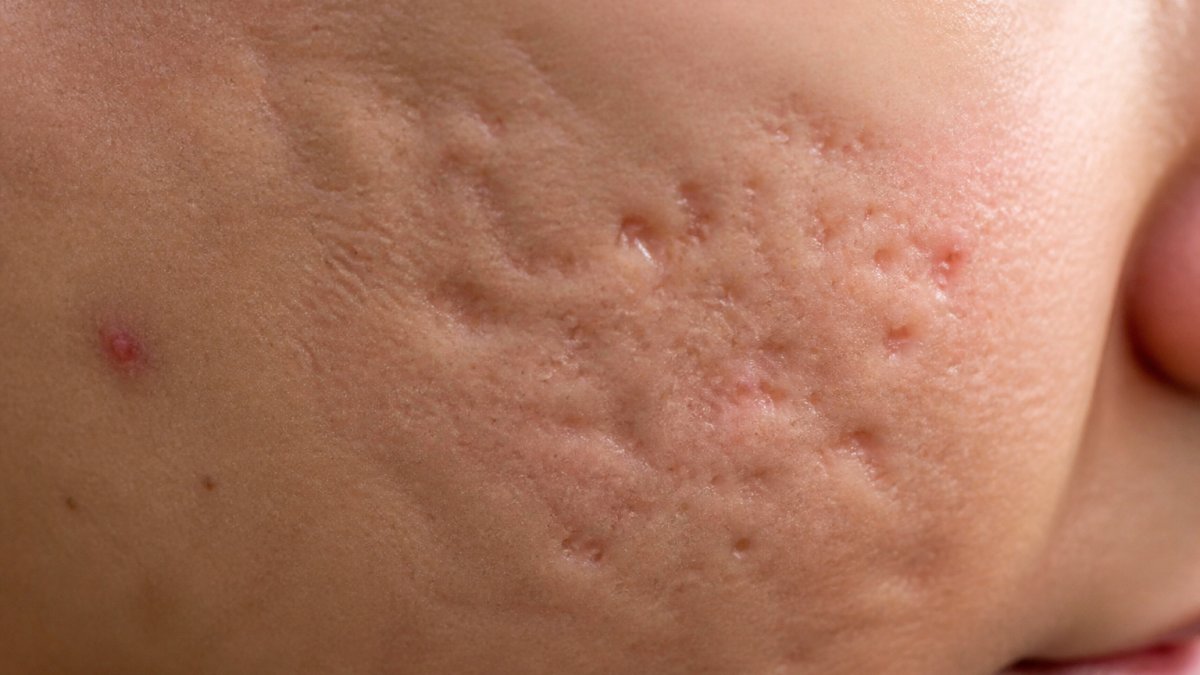
Rolling acne scars create a distinctive wave-like or undulating appearance across the skin surface. They look less like distinct holes and more like gentle waves frozen in your skin, the depressions are broad, shallow to moderate in depth, and blend gradually into surrounding skin rather than dropping off sharply.
The Wave-Like Depression Pattern
Rolling scars form when fibrous bands beneath the skin pull the surface downward unevenly. The depressions are typically wider than they are deep, spanning several millimeters across. When you look at rolling scars, the edges slope gradually rather than forming sharp walls.
The surface texture feels uneven to the touch. Surrounding skin appears relatively normal, but as you move across a rolling scar, you’ll notice the gentle dip and rise.
Dermal Tethering and Skin Mobility
What distinguishes rolling scars from other depressed scars is dermal tethering: fibrous bands of collagen anchored deep in the skin pull the surface downward.
When you stretch the skin around a rolling scar, the depression often becomes less visible or disappears temporarily.
This mobility characteristic also explains why rolling scars respond well to treatments that break up fibrous bands, such as subcision or microneedling.
Rolling and boxcar scars have distinct structural differences that determine how they respond to treatment.
| Characteristic | Rolling Scars | Boxcar Scars |
|---|---|---|
| Edge appearance | Sloping, gradual blend | Sharp, angular, defined |
| Depth pattern | Broad, shallow to moderate | Narrow, consistent depth |
| Surface texture | Wave-like, undulating | Distinct depression, flat base |
| Stretch test response | Improves or flattens | Remains largely unchanged |
| Underlying cause | Dermal tethering | Loss of dermal support |
| Lighting visibility | More visible at side angles | Casts distinct shadow |
| Best treatment approach | Subcision, microneedling | Laser resurfacing, fillers |
Boxcar Acne Scar Appearance and Defining Characteristics
Boxcar scars look fundamentally different from rolling scars. They appear as distinct, sharply defined depressions with relatively flat bases and steep or vertical edges. The name itself is descriptive: imagine a boxcar shape, a defined rectangular or angular depression with clear boundaries rather than gradual slopes.
Sharply Defined Edges and Flat Base
The most obvious visual difference is edge definition. Boxcar scars have sharp, defined perimeters where the scar meets normal skin. The edges aren’t sloping or gradual; they’re more angular or vertical.
The base of a boxcar scar is relatively flat compared to the surrounding skin.
In lighting, boxcar scars cast a distinct shadow because of their sharp edges and flat base. This shadow effect makes them more visible in certain angles and lighting conditions.
Consistent Depth and Immobile Depressions
Unlike rolling scars, boxcar scars don’t improve visibly when you stretch the skin. This is the second key identifier. When you perform the stretch test on a boxcar scar, the depression remains largely unchanged.
Boxcar scars form when acne inflammation destroys a column of dermis (the deeper skin layer), leaving a depression with insufficient collagen to fill the space.
The depth and width of boxcar scars are typically consistent across the depression. You won’t see the variation in elevation that characterizes rolling scars.
How to Identify Acne Scar Types Through Self-Assessment
Identifying your scar type at home requires a systematic approach, though it’s important to understand the limits of self-assessment. A dermatologist can confirm your scar morphology with clinical examination and may identify mixed patterns or nuances that affect treatment selection.
The Stretch Test and Its Limitations
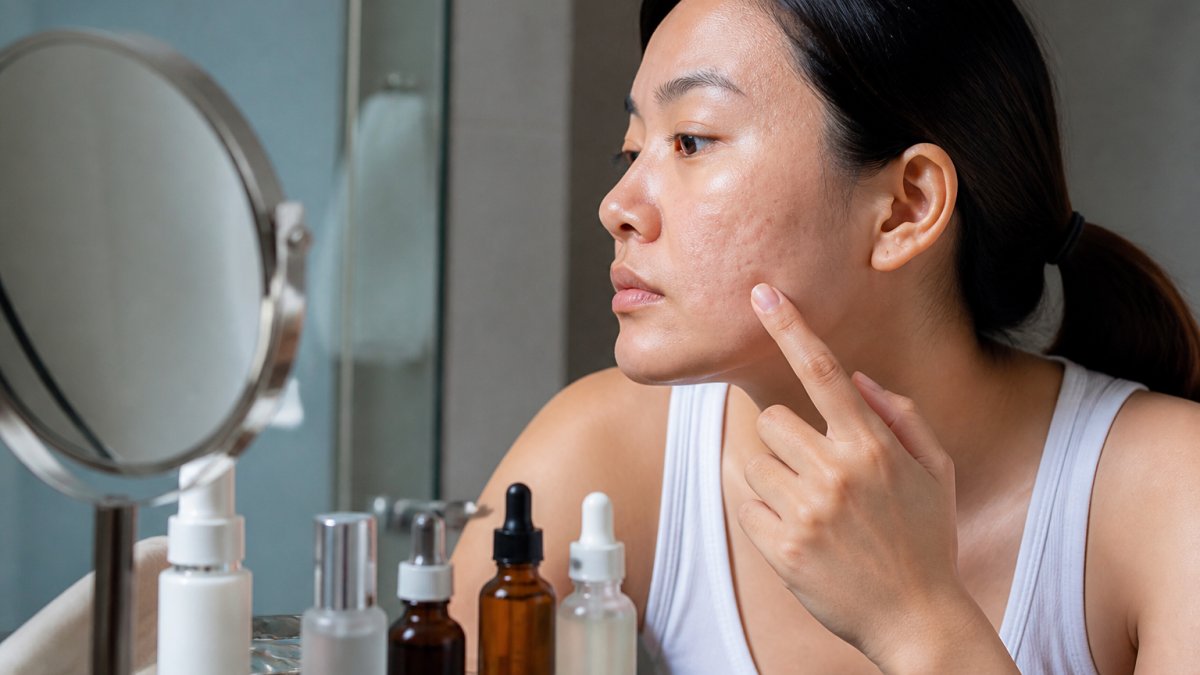
The stretch test is a practical starting point. Gently pull the skin around your scars in different directions, horizontally, vertically, and diagonally.
If depressions improve or nearly disappear with stretching, you likely have rolling scars caused by dermal tethering. If they remain largely unchanged despite stretching, boxcar scars are more likely.
However, this test has real limitations. Mixed scar patterns, areas with both rolling and boxcar characteristics, won’t give you a clear answer.
Examining Scar Edges, Depth, and Width
Beyond the stretch test, examine your scars directly using good lighting. A handheld mirror and natural side lighting (near a window) work well for this examination.
Look at the edges first. Are they sharp and angular, or do they slope gradually? Boxcar scars have defined, angular edges.
Next, assess depth and width. Boxcar scars are typically narrow with consistent depth.
Feel the surface texture. Rolling scars create an uneven, wavy texture. Boxcar scars feel like distinct depressions with relatively uniform bases.
Mixed Scar Patterns and Skin Tone Considerations
Many people have mixed scar patterns, some areas with rolling characteristics and others with boxcar features. Individual depressions within a scarred area might vary significantly.
When you have mixed patterns, treatment often needs to address both scar types. Some treatments work well for rolling scars but less effectively for boxcar scars, and vice versa.
Skin tone and skin type also influence how clearly you can see scar morphology. Darker skin tones may show post-inflammatory hyperpigmentation alongside scarring, discoloration from acne inflammation that persists after the acne heals (the American Academy of Dermatology).
Post-inflammatory hyperpigmentation is a separate concern from scar morphology but often occurs together. Identifying both helps you choose treatments that address the full picture of your skin’s needs.
Acne Scar Treatment Options by Morphology
Different scar types respond to different treatment mechanisms, which is why identifying your scar morphology matters for treatment selection.
Rolling Scars and Treatment Response
Rolling scars, with their tethered collagen and skin mobility issues, respond well to treatments that break up fibrous bands or stimulate collagen remodeling. Subcision, a technique where a professional inserts a needle beneath the scar to release tethered tissue, directly addresses the underlying cause of rolling scars (A Combination Approach to Treating Acne Scars in All Skin Types).
Chemical peels work for rolling scars by removing surface layers and stimulating collagen production, though they’re typically more effective when combined with other treatments. Laser resurfacing can also address rolling scars by removing damaged surface tissue and triggering deeper collagen remodeling.
Treatment outcomes for rolling scars tend to be more predictable because the underlying mechanism, tethering, can be directly addressed. Most people see gradual improvement over multiple sessions, though complete elimination is rare.
Boxcar Scars and Treatment Response
Boxcar scars require different approaches because they’re defined by loss of dermal support rather than tethering.
Boxcar scars respond better to resurfacing treatments that remove the sharp edges and create a more gradual transition to surrounding skin.
Microneedling can help boxcar scars by stimulating collagen production, though results are typically more modest than with rolling scars. Multiple sessions are usually needed, and improvement is gradual.
At-Home Chemical Peels as Part of Your Routine
At-home chemical peels offer a practical option for addressing both scar types as part of a comprehensive skincare routine. Learn how to safely apply chemical peels at home to minimize risks and maximize results.
For rolling scars, regular chemical peels can help improve skin texture and support collagen remodeling, especially when combined with other treatments.
The advantage of at-home peels is consistency and accessibility. You can explore professional-grade options that fit your specific skin needs and scar type.
Makeup Artist’s Choice offers a range of professional-grade chemical peels formulated to address various skin concerns, including acne scarring and texture irregularities.
When to Seek Professional Assessment
Self-assessment is valuable for initial understanding, but professional evaluation has real advantages, especially if you’re considering more aggressive treatments or if your scars are extensive.
A dermatologist can confirm scar morphology with clinical examination and identify nuances that affect treatment selection.
Professional assessment is particularly important if you’re considering treatments like subcision, laser resurfacing, or dermal fillers.
Additionally, a professional can rule out other skin conditions that might mimic scarring or complicate treatment.
Start Your Scar Improvement Journey
Identifying whether you have rolling vs boxcar acne scars is the foundation for choosing treatments that actually work. Rolling scars respond to treatments that address tethering and stimulate collagen remodeling. Boxcar scars need resurfacing or filling approaches that address the underlying loss of dermal support.
The comparison between chemical peels and microneedling can help you understand how different professional treatments approach acne scar morphology. For at-home care, professional-grade chemical peels offer a consistent, accessible option for supporting skin texture improvement over time. Targeted scar treatment products specifically formulated for acne scars can complement your routine and address both scarring and post-inflammatory hyperpigmentation.
At Makeup Artist’s Choice, we understand that acne scarring affects how you feel about your skin. Our professional-grade chemical peels and customized skincare routines are designed to support real improvement through consistent, evidence-based treatment.
Frequently Asked Questions
What does a rolling acne scar look like?
Rolling acne scars appear as broad, wave-like or undulating depressions in the skin. Rather than sharp indentations, they have sloping, gradual edges that blend into surrounding skin. The skin surface looks wavy or uneven when viewed from the side. Rolling scars typically result from dermal tethering, where fibrous bands pull the skin downward, creating that characteristic rolling appearance. They often span wider areas than boxcar scars and may improve slightly when skin is stretched.
How can you tell rolling acne scars from boxcar scars?
Rolling scars have broad, sloping edges and wavy depressions, while boxcar scars feature sharply defined, steep edges with a flatter base. Rolling scars often improve when skin is stretched (a simple self-check), whereas boxcar scars remain unchanged. Boxcar scars look like small, punched-out indentations with distinct boundaries, whereas rolling scars blend gradually into surrounding skin. The key difference in scar morphology is edge definition: rolling scars are soft and gradual, boxcar scars are crisp and defined.
Can one person have both rolling and boxcar acne scars?
Yes, many people have mixed scar patterns. Widespread acne can create different types of scars depending on how inflammation affected the skin at each site. One area may have rolling scars from dermal tethering, while another has boxcar scars from deeper, more localized damage. When identifying your acne scar types, examine each depression individually rather than assuming all your scars match one category. Mixed patterns are common and may require a combination of treatment approaches for optimal results.
Should I see a dermatologist to confirm my scar type?
A dermatologist can definitively classify your acne scars and recommend treatment based on scar morphology, skin type, and depth. While self-assessment helps you understand your scars, professional evaluation ensures accurate diagnosis and realistic treatment expectations. This is especially important if you have post-inflammatory hyperpigmentation, sensitive skin, or deep scars. A dermatologist can also determine whether at-home treatments like chemical peels are appropriate for your specific scar type and skin condition.
The path to improved skin texture begins with understanding what you’re treating. Identify your scar type, select treatments designed for that morphology, and support your routine with professional-grade skincare products formulated to address acne scarring and skin texture concerns.